Scaling Is a Systems Problem Not a Logistics One
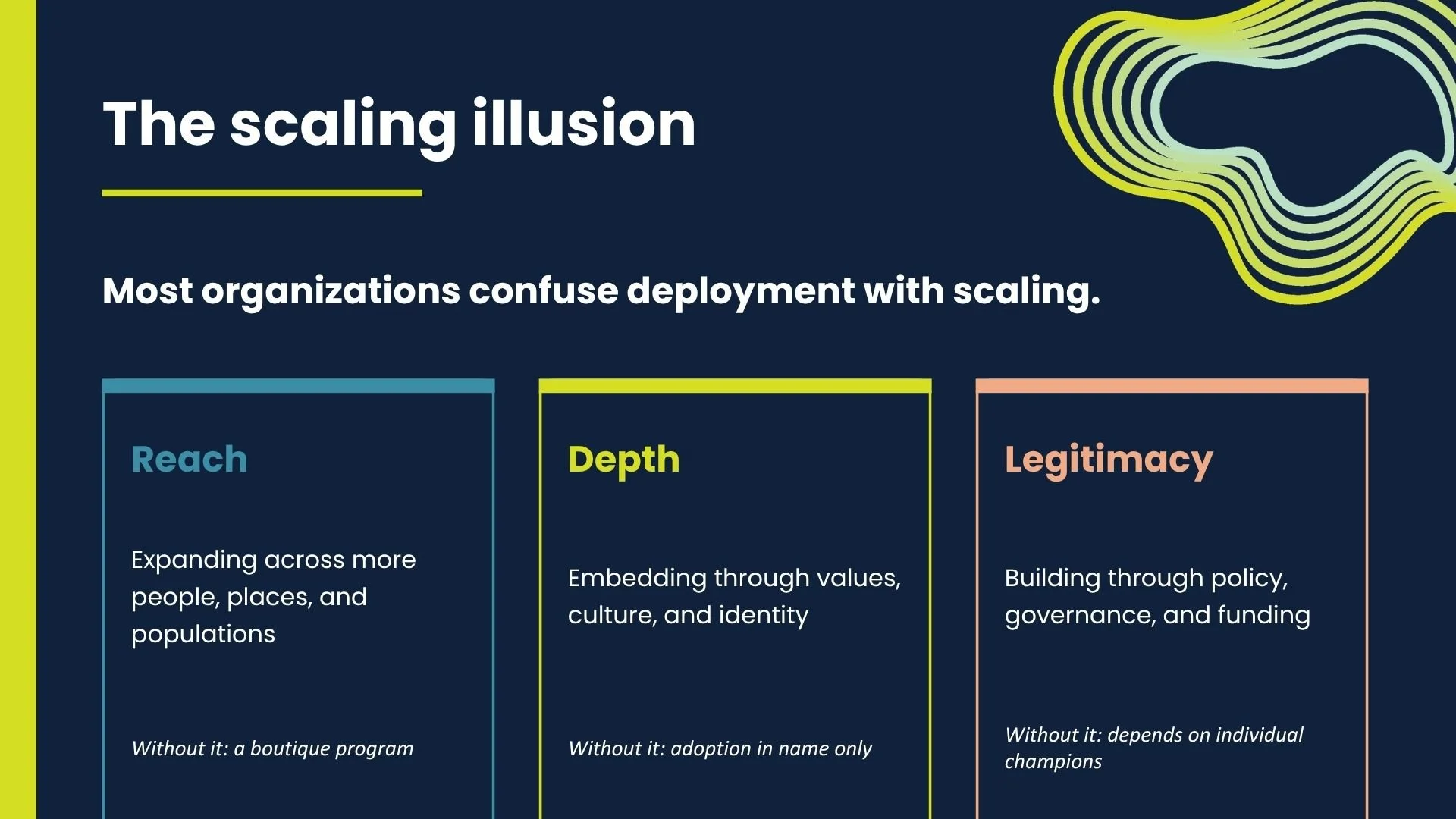
Most organizations confuse deployment with scaling.
They replicate a pilot, call it a rollout, and then wait for the results to follow. When they don't, the instinct is to push harder,” more communications, more project management discipline. The problem, almost always, isn't execution. It's the mental model.
Scaling a complex social innovation is not a logistics problem. It is a systems problem. And systems problems don't respond well to project management solutions.
The Scaling Illusion
True scaling of complex innovation requires three simultaneous movements: expanding reach across more people, places, and populations; embedding depth through values, culture, and identity; and building legitimacy through policy, governance, and funding.
Most organizations manage the first. Some manage the second. Very few consistently work all three, and even fewer recognize that all three must move together.
Without reach, you have a boutique program. Without depth, you have adoption in name only. Without legitimacy, you have something that depends on individual champions to survive. With all three, you eventually have a standard,” something that persists because it has been absorbed into the system itself, not just bolted onto it.
That distinction between a program that runs and a standard that holds is the real goal of scaling.
Three Layers, Three Problems
The most robust scaling strategies work at three distinct levels simultaneously, and treat each as a distinct problem requiring a distinct strategy.
Layer One: Systemic Scaling
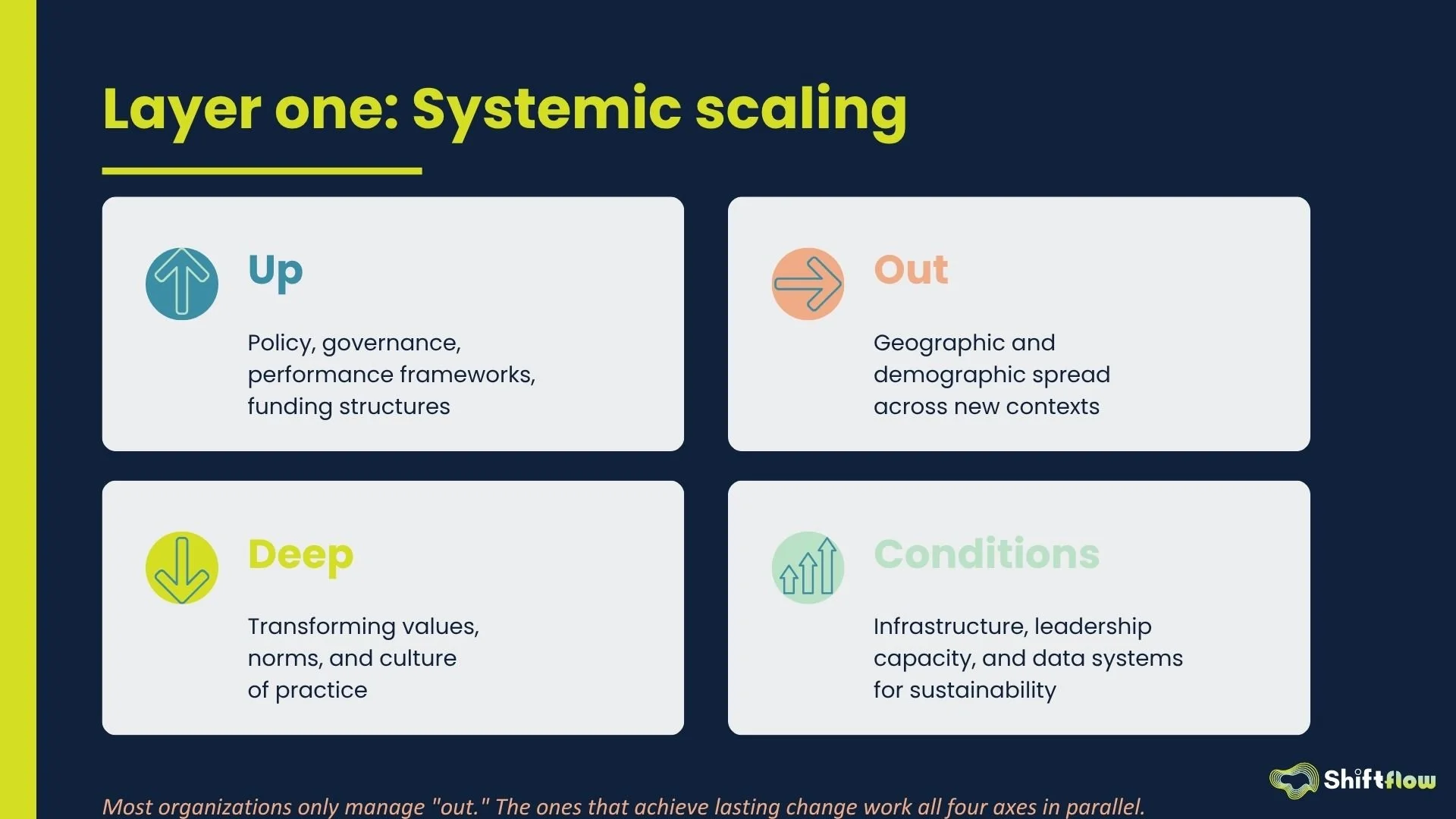
At the system level, scaling operates along at least four axes. Up means embedding into policy, governance, performance frameworks, and funding structures, making the innovation visible and legitimate at the institutional level. Out means geographic and demographic spread,” reaching new contexts and populations. Deep means transforming the underlying values, norms, and culture of practice. And Conditions means building the infrastructure, leadership capacity, financial and networks to support conditions of scaling.
Most organizations only manage "out." They measure scaling by spread, by how many sites, how many users, how many regions. But an innovation that has spread without going up, deep, or into the conditions is fragile. It is entirely dependent on the continued effort of the people who pushed it there.
The ones that achieve lasting change work all four axes in parallel, not at the same pace, but with deliberate attention to each.
Layer Two: Social Adoption
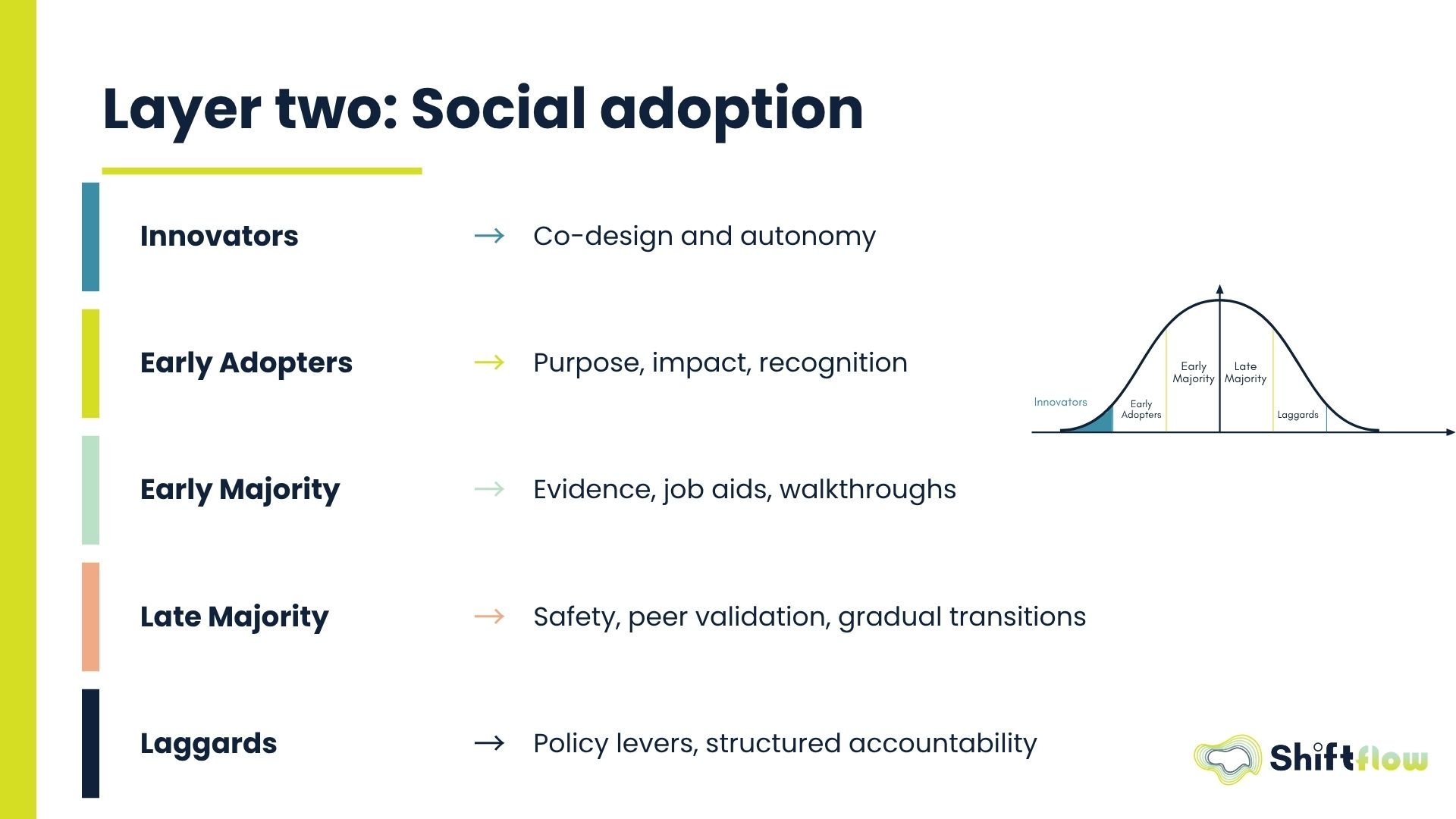
People don't adopt innovation uniformly. Treating them as if they do is one of the most common and most avoidable scaling failures. Rogers' adoption curve gives us a map that is worth taking seriously.
Innovators want to shape the future. They respond to co-design opportunities and autonomy. Early adopters are motivated by purpose and impact; they respond to story, recognition, and early leadership roles. The early majority want practical ease: evidence, job aids, clear walkthroughs. The late majority want safety and support; they need guarantees, peer validation, and gradual transitions that don't disrupt what is already working. And laggards, in complex systems, often require policy levers and structured accountability to move at all.
The insight here is that the same innovation requires five different campaigns. Not five different innovations; five different approaches to the same one, and treating each as an opportunity to adapt and evolve the innovation.
Layer Three: Individual Change
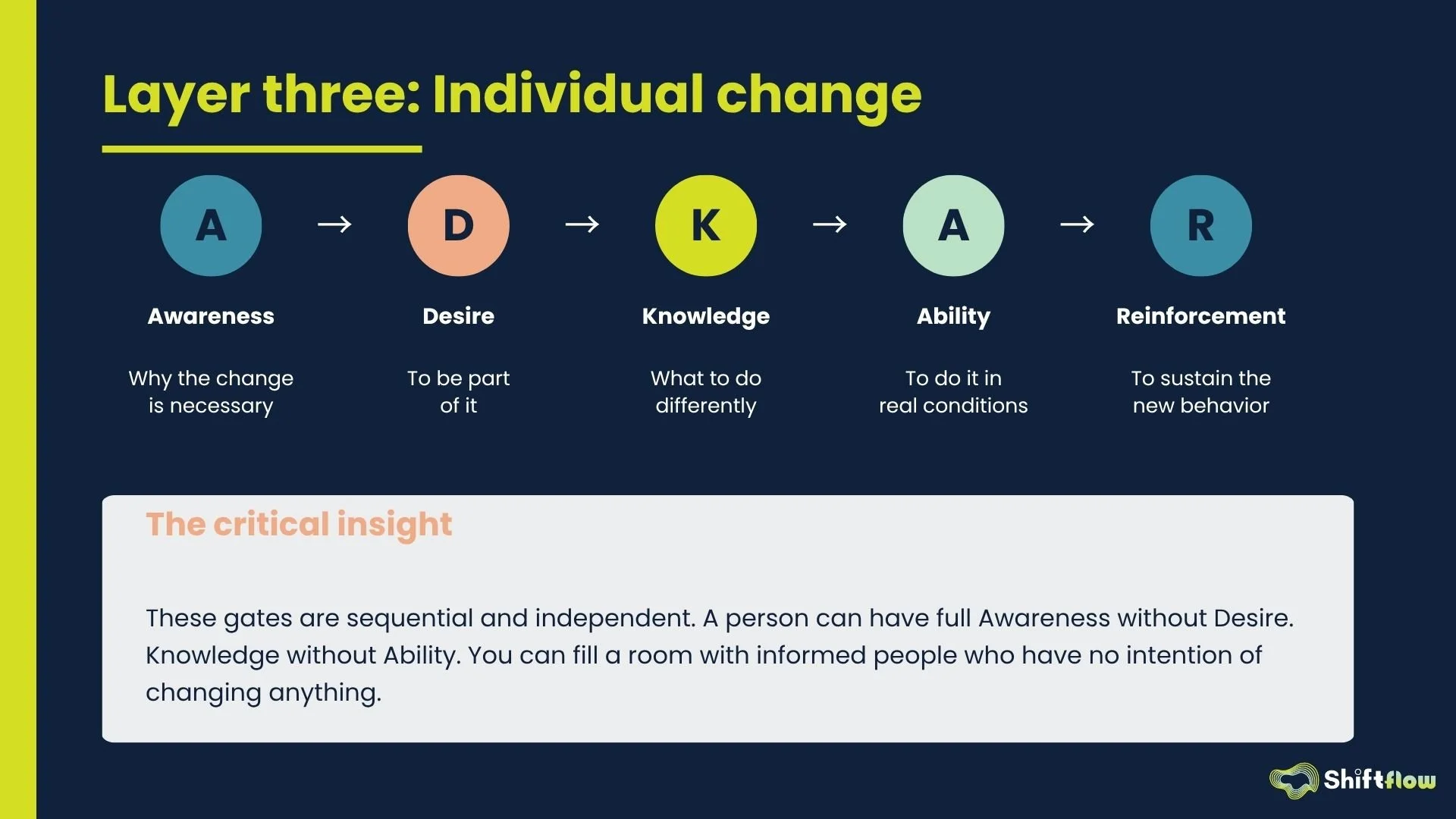
Even when the system is ready and the social environment is supportive, individuals can stall. The ADKAR model names five internal gates that every person must pass through: Awareness of why the change is necessary; Desire to be part of it; Knowledge of what to do differently; Ability to actually do it in real conditions; and Reinforcement that sustains the new behaviour over time.
The critical insight is that these gates are sequential and independent. A person can have full Awareness without Desire. Knowledge without Ability. Ability without the Reinforcement that keeps it going. Treating these states as interchangeable is why training programs fail. You can fill a room with informed people who have no intention of changing anything.
The Architecture of a Living Rollout
With those three layers in mind, the question becomes structural: how do you actually organize a scaling effort across time?
The most useful frame involves three distinct concepts that are frequently conflated.
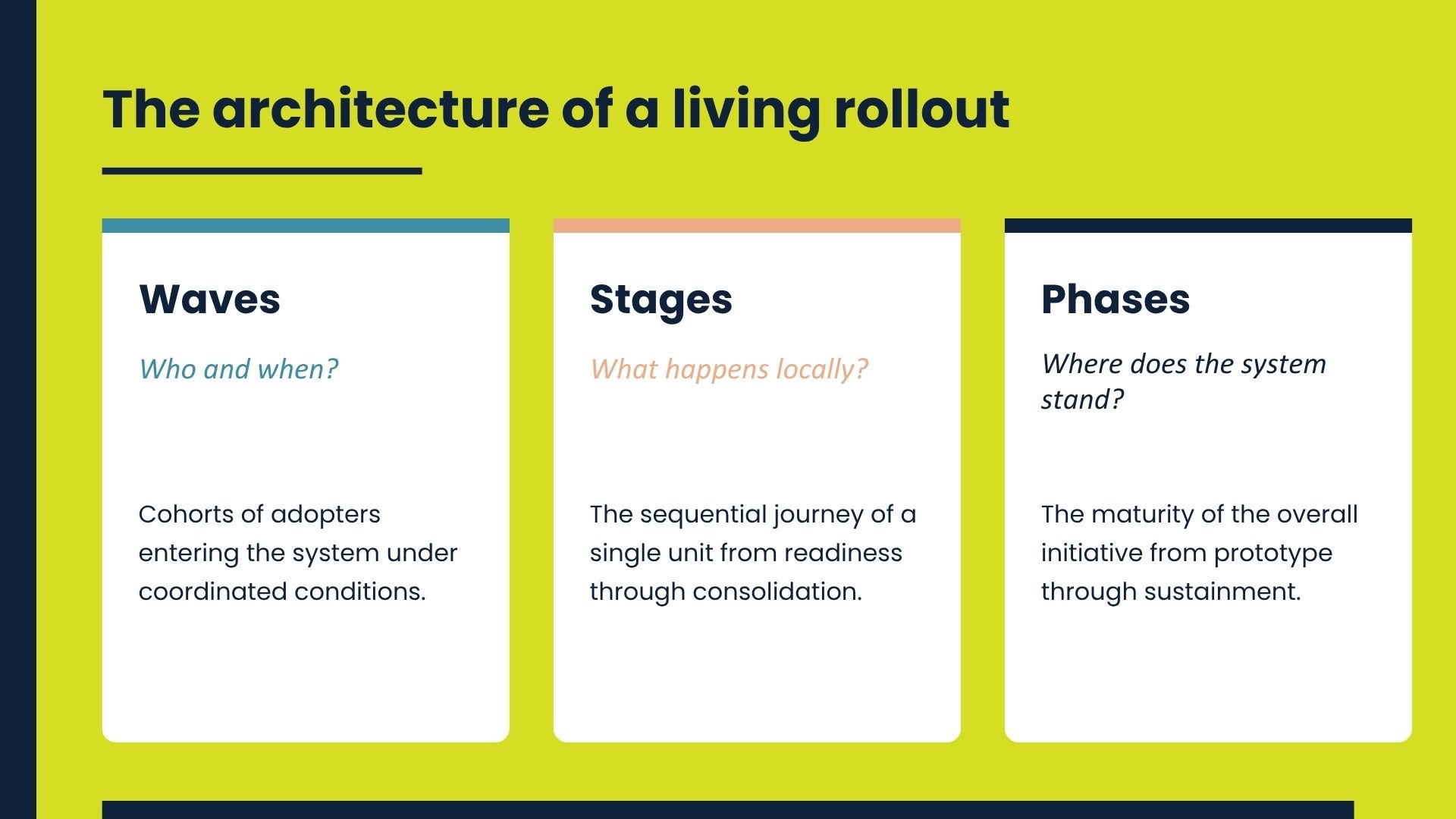
Waves answer who and when: the cohorts of adopters entering the system under coordinated conditions.
Stages answer the question of what happens locally: the sequential journey of a single unit or team from readiness through consolidation.
Phases answer the question of where the whole system stands: the maturity of the overall initiative from prototype through sustainment.
These are not the same thing, and conflating them produces a specific and common failure mode: system leaders declare victory at the phase level while individual teams are still stuck in early stages. The announcement goes out. The project is marked complete. And the sites are left to figure it out on their own.
Alongside this, scaling should never be an all-or-nothing proposition. A building-block approach, launching with core essentials and layering in complexity as confidence and capability grow, reduces the psychological barrier to entry, creates early wins that generate social proof, and allows learning from early implementation to shape what comes next. The minimum viable version of a program is not a compromise. It is often the wisest place to start.
Every scaling initiative also faces one recurring strategic decision: move fast across multiple sites simultaneously, or consolidate depth before breadth? Neither is universally right. The answer should be governed by evidence; the readiness and capacity of receiving sites, the availability of enabling infrastructure, and the quality of learning captured from earlier waves. Build the decision criteria before you need them. Make the call with data, not momentum.
Scaling Without Learning Is Just Copying
The innovations that sustain themselves build feedback loops into the rollout's structure as an operating principle.
Traditional evaluation asks: Did it work? Developmental evaluation asks: How, why, and under what conditions? For complex innovation in dynamic systems, the second question is the only honest one. It treats the model as evolving rather than fixed. It builds learning into implementation rather than bolting it on at the end.
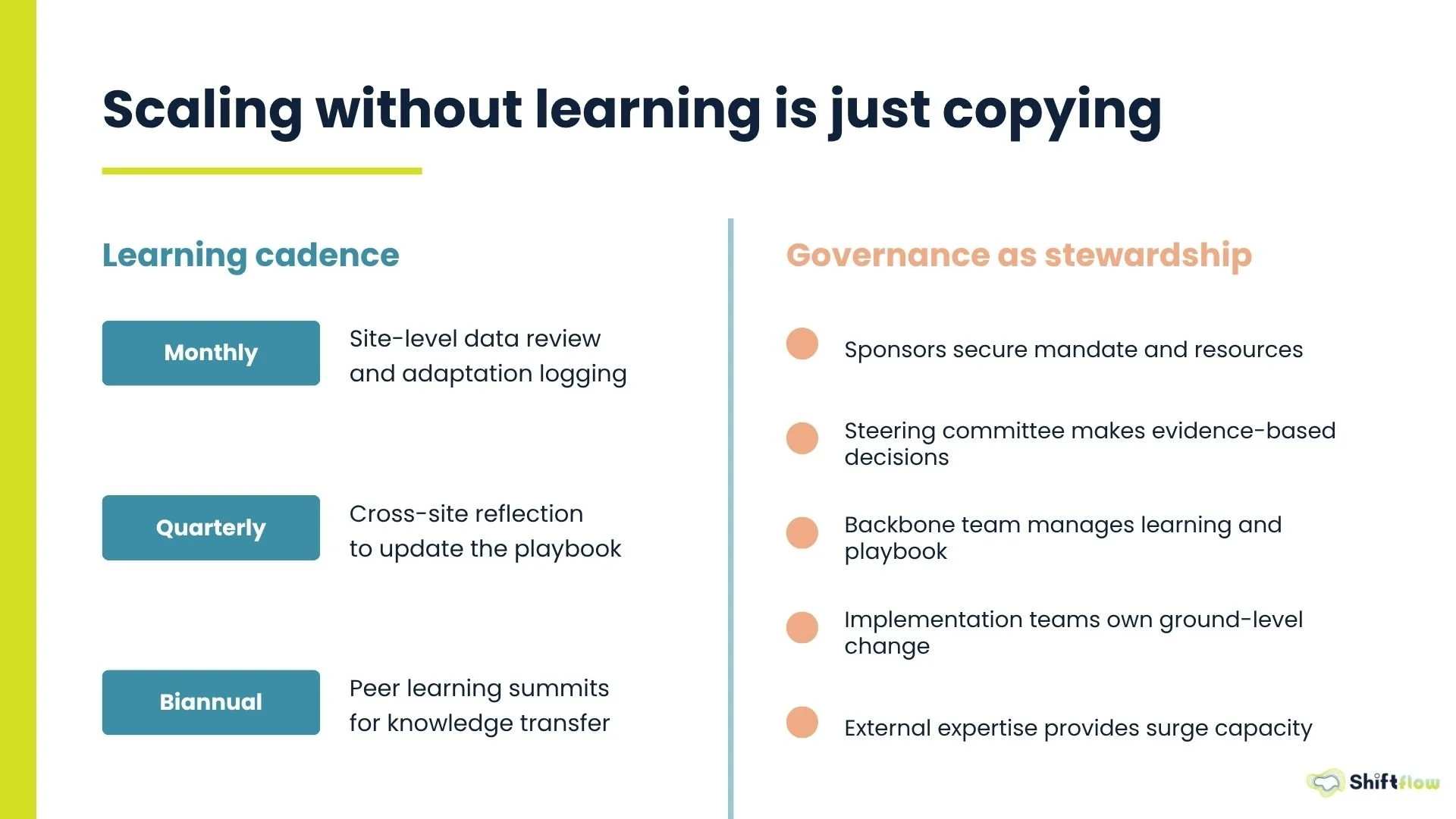
In practice, this means building a cadence: monthly site-level data review and adaptation logging; quarterly cross-site reflection to identify patterns and update the playbook; and biannual peer learning summits that bring together early and later adopters for real knowledge transfer, recognition, and co-design of what comes next.
It also means making an explicit, documented decision about what must stay the same and what can change. A "core vs. adaptable" framework forces the team to distinguish between non-negotiable principles and locally-variable practices before sites start making their own calls in the dark. Informal drift, where each site quietly customizes the model until there is no longer a model, is one of the most common ways scaling fails silently.
Governance as Stewardship
The governance structure for scaling complex innovation should operate less like a hierarchy and more like stewardship. Those in governance roles are not owners of the innovation but custodians of it. Their accountability is not upward to authority but outward to the work and the people doing it.
The key structural roles are not complicated, but they must be clearly held. Sponsors secure mandate, resources, and policy alignment. A steering committee makes evidence-based strategic decisions and arbitrates cross-site tensions. The backbone or secretariat manages learning, communication, and the playbook across all waves. Implementation teams adapt centrally-designed tools to local realities and own the ground-level change. And external expertise provides surge capacity for evaluation, technical integration, and specialized support.
What distinguishes stewardship from management is the direction of accountability. Stewards hold something on behalf of others. They tend conditions, protect relationships, and pass on what they've built rather than holding onto it. A scaling plan that creates lasting capability looks fundamentally different from one that creates lasting dependency on the centre. The test of good stewardship is not that governance was present throughout, but that its presence made local ownership possible.
The Part That Doesn't Fit in a Framework
No amount of strategic architecture survives contact with a workforce that hasn't been brought along.
Peer learning is the most underrated tool in scaling. When early adopters share their real experiences, including failures, with later sites, they do something that no training curriculum can: they make the change feel possible. A peer who has already walked the path and is willing to say what was hard about it carries more influence than any formal communication. Recognition, storytelling, and structured peer mentorship accelerate adoption more reliably than almost any other investment.
The social and emotional dimensions of change deserve the same rigour as the operational ones. They are not soft. They are often the constraint.
What Success Actually Looks Like
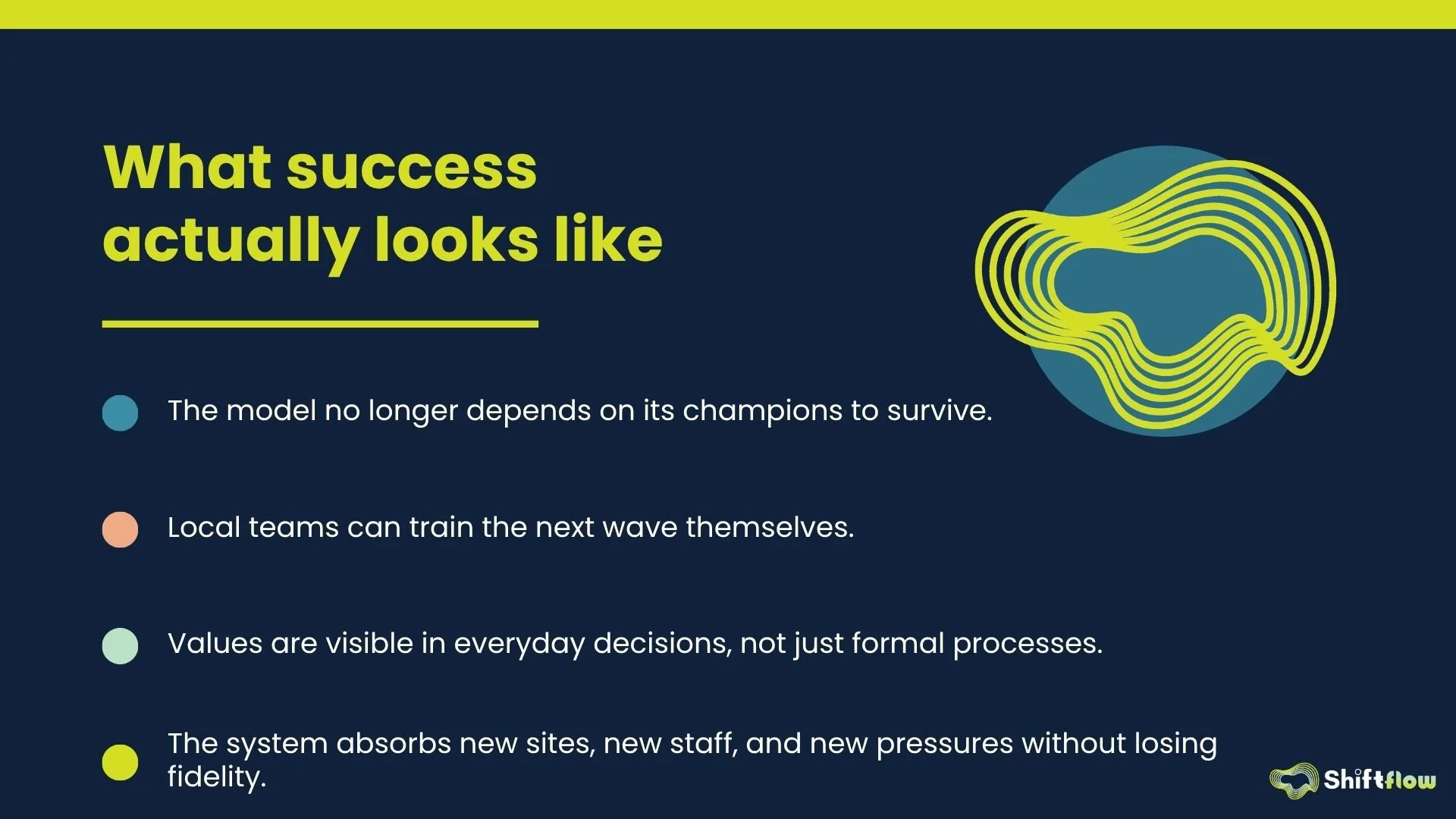
True scaling success isn't a launch announcement or a completion rate.
It's when the model no longer depends on its champions to survive. When local teams have the capability and confidence to train the next wave themselves. When the values behind the innovation are visible in everyday decisions, not just formal processes. When the system can absorb new sites, new staff, and new pressures without losing fidelity.
That is the difference between scaling a program and scaling a practice.
The hardest part of scaling isn't the rollout. It's resisting the temptation to call something scaled when it's only been deployed. The framework above demands more: more patience, more structure, more honest measurement. But it also produces something the shortcut never does: durable change and lasting impact.