Another Walk in the Snow
Why Organizational Change Fails: Path Dependence and Culture Change
Culture does not change through announcements. It changes through repeatedly walking new paths until they become the obvious route. Here is why the old ones persist, and who benefits from them persisting.
There is a paradox at the heart of most organizational change efforts: we ask people to behave differently while leaving intact the very conditions that shaped how they behave now. We announce new values, launch new programs, and then wonder why nothing seems to shift. The system absorbs the intervention and carries on.
I think about this through a simple image. Fresh snow. I have written about this in the past and thought since we are saying goodbye to winter, I thought it was worth revisiting.
It goes something like this:
Picture your mind as an open field of fresh snow. Across that field are destinations: ways of thinking, ways of responding, ways of behaving, ways of relating to others. Every time you travel to one of those destinations, you leave a path. The more you travel a path, the deeper and wider it becomes. Over time, that path becomes the obvious route. Not because it is the best one, but because it is the easiest one. The snow is already packed. The friction is gone.
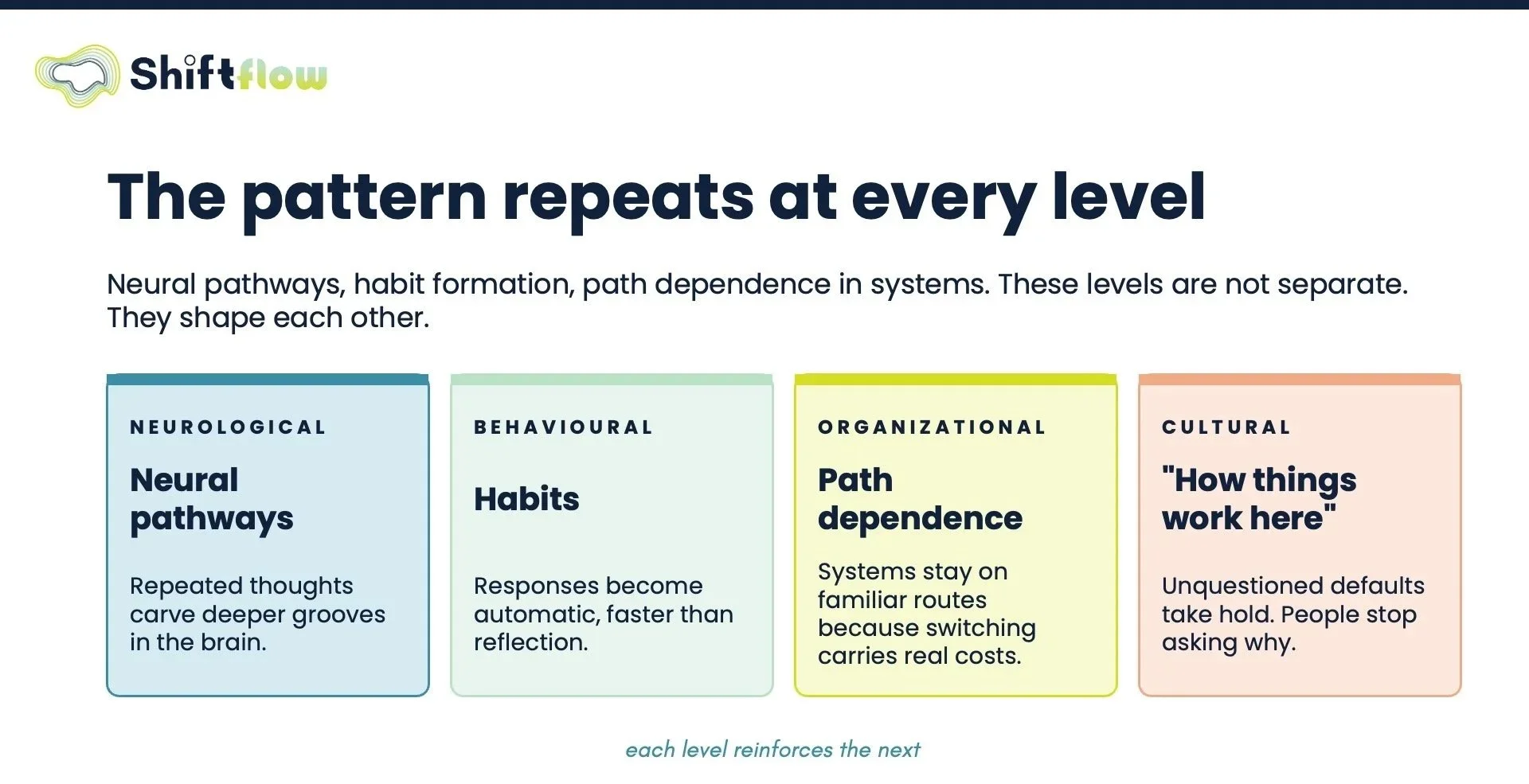
This maps directly onto what we know about neural pathways, habit formation, and what economists call path dependence: the tendency for systems to stay on familiar routes because switching carries real costs. The pattern repeats at every level: neurological, behavioural, organizational, and cultural. The AHA moment I had was realizing that these levels are not separate. They shape each other.
The Path That Feels Rational
When an organization has always made decisions a certain way, that is not just a structural choice. It is a well-worn path. People have stopped questioning it. It has become, to borrow a phrase, "just how things work here." A new org chart does not change that. A new strategy document does not change that. What changes it is, in part, people repeatedly choosing a different route, until the new path is more worn than the old one.
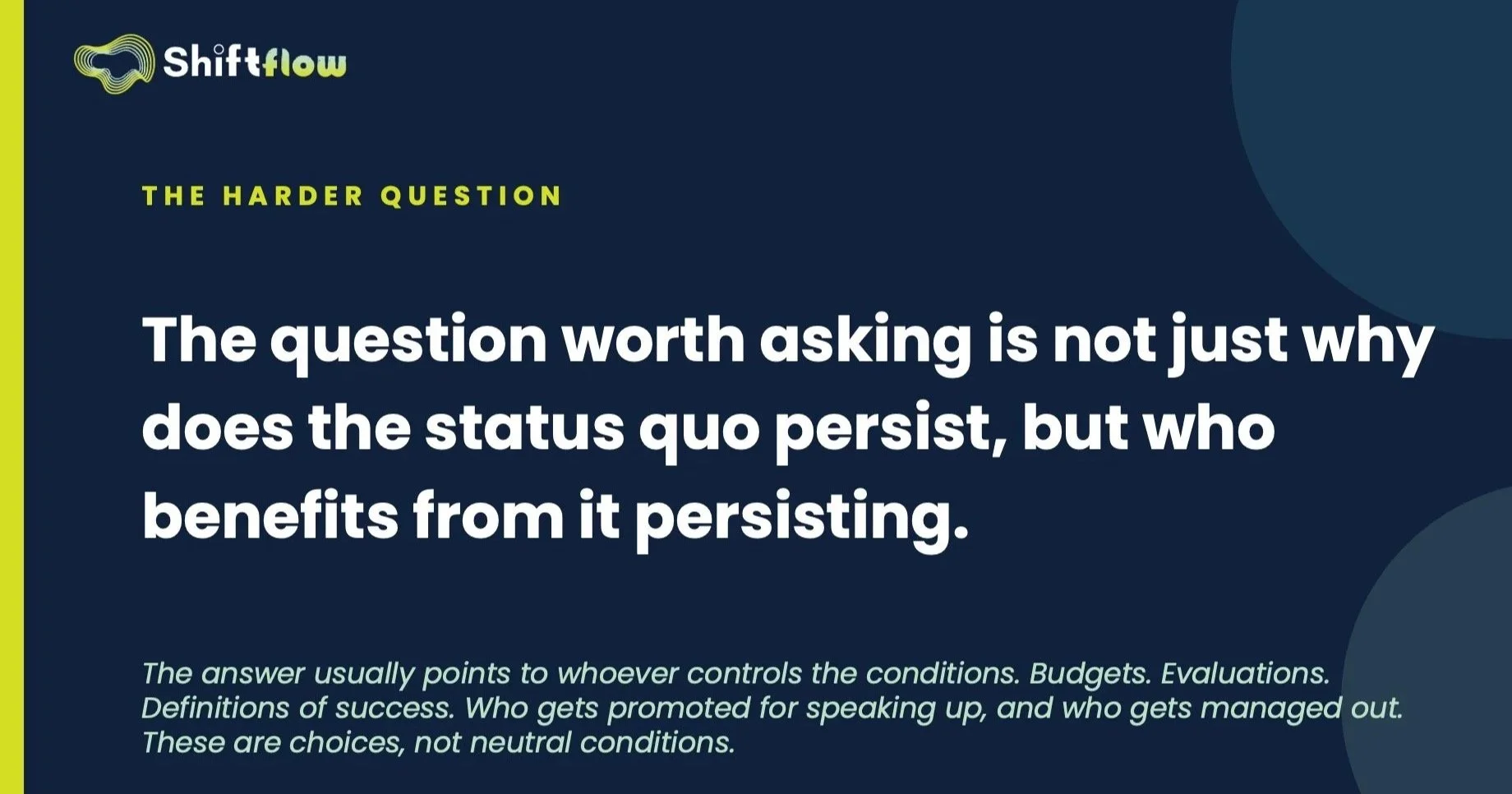
Conversely, people do not stay on familiar paths only because ‘the snow is packed.’ They stay because leaving the path can cost them something. Approval. Opportunity. Safety. The question worth asking is not just why does the status quo persist but who benefits from it persisting. The answer usually points to whoever controls the conditions that make the old path feel like the rational choice. They control the budgets, the evaluations, the definitions of success, the post-incident reviews that decide whose judgment was sound and whose was reckless; who gets promoted for speaking up, and who gets managed out; whose judgment is trusted after a failure, and whose is not. These are not neutral conditions. They are choices, often made deliberately, that make certain paths feel safe and others feel career-limiting. Cognitive inertia is real, but it does not operate in a vacuum. It is reinforced by systems that reward compliance with the existing route.
Who Benefits From the Old Route
Here is what makes this difficult in practice: the person controlling those conditions is not always who you think. It is often not the executive sponsor or the senior champion. It is the mid-level gatekeeper who decides which experiments get resourced, which voices survive a debrief, and which lessons from failure actually travel up the chain. Real recognition of the terrain means naming that honestly, not just gesturing at "power and incentives" in the abstract. If you are in the top three layers of the organization, this is your responsibility.
Most culture change efforts get this backwards. They focus on the destination without attending to the terrain. They describe the new behaviours they want to see, without recognizing that existing behaviours are not random.They are the accumulated result of thousands of small decisions, each one reinforcing a path that already existed.
Why the Brain Stays on the Familiar Path
The deeper problem is cognitive. Our brains did not evolve for novelty. They evolved for survival, which means defaulting to the familiar. Unfamiliar territory reads as risk. That cognitive bias is not a personal failing. It is a feature that kept our ancestors alive. It is also a serious obstacle when the work requires trying something new, engaging with an unfamiliar perspective, or redesigning how a team makes decisions.
So when people resist change, I do not think they are being difficult. I think they are doing exactly what their minds are wired to do: staying on the path they know.
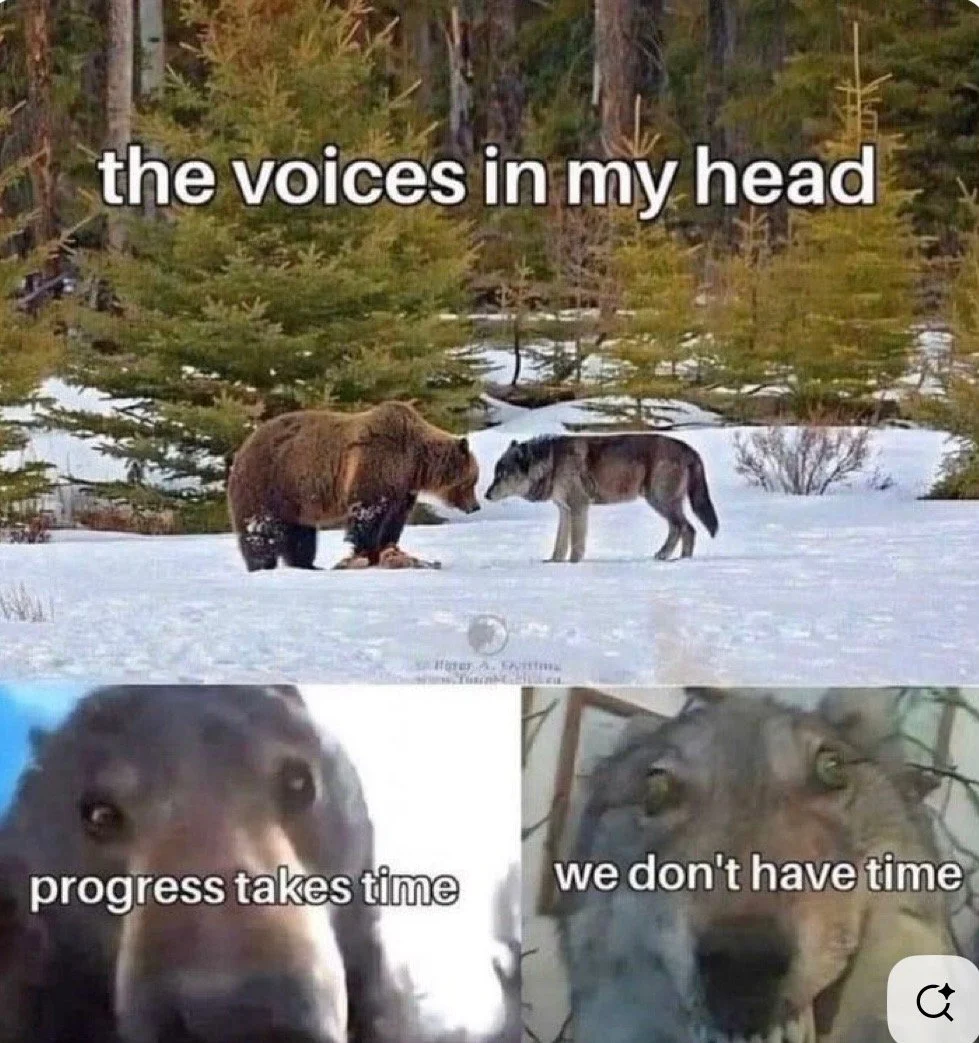
The implication for organizational change is significant. If you want to shift culture, you have to create conditions where new paths get travelled repeatedly. Not just announced, not just documented, but actually walked. And recognize that walking new paths will require more effort, more time, and more preparation than the usual route.
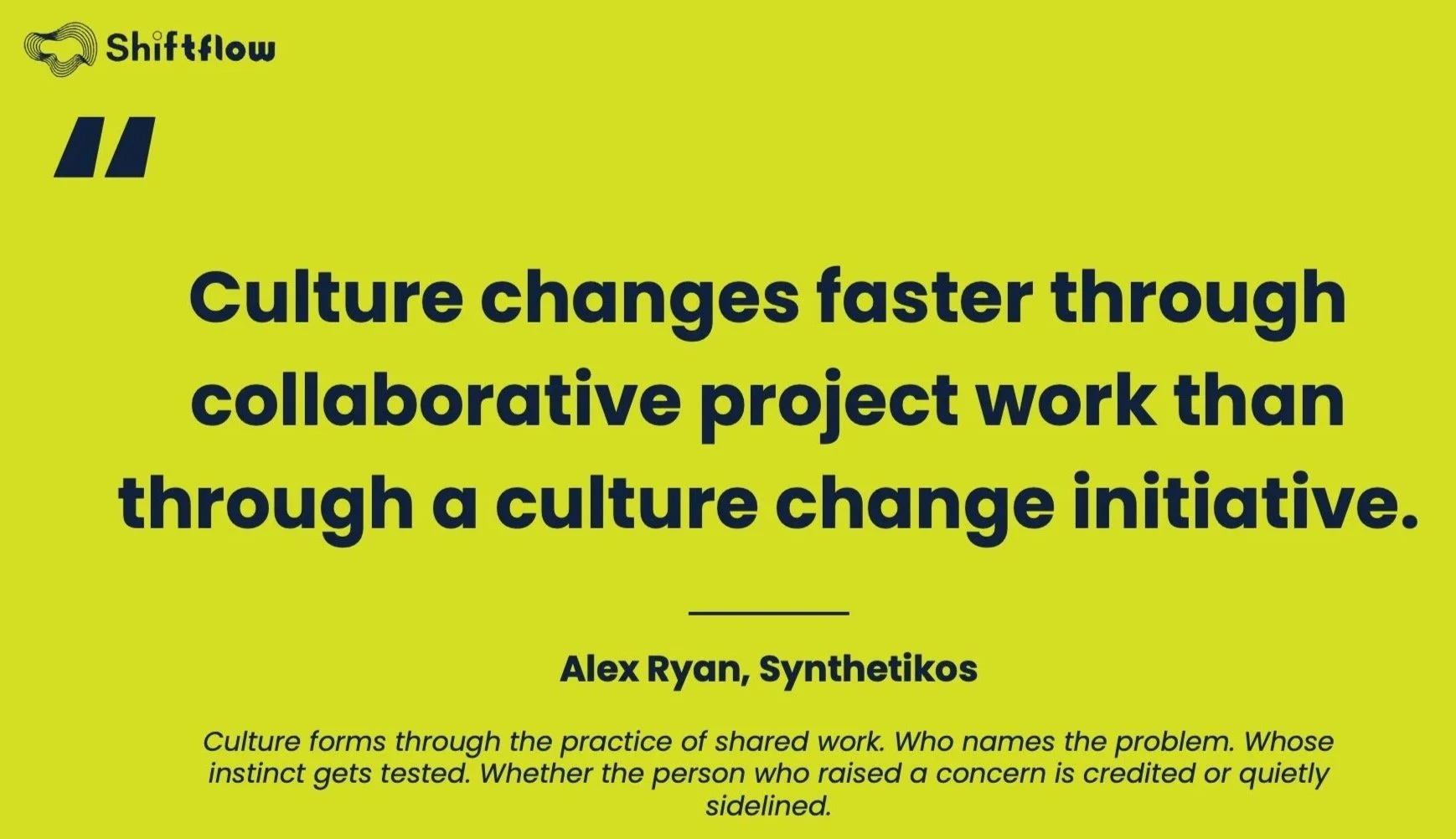
Alex Ryan put it well: "culture changes faster through collaborative project work than through a culture change initiative."
He means that culture forms through the practice of shared work: who gets to name the problem, whose instinct gets tested, whether the person who raised a concern at the start is credited or quietly sidelined at the end. Workshops about psychological safety do less than creating a real project where people experience what it feels like to speak up and be heard. A values statement does less than a senior leader visibly changing how they respond to failure. The path forms through use, not intention.
Recognition, Design, Demonstration
These three points are what I keep coming back to in my work with organizations.
The first is recognition. This is harder than it sounds. Most people do not see the paths they are walking. They do not notice the reflex to defer to authority, to avoid conflict, to measure success in outputs rather than outcomes. Naming these patterns is the beginning of choosing differently. But recognition has a more uncomfortable layer. Some paths persist not because people are unaware, but because the people with the power to change them have little reason to. Honest recognition asks not just what patterns are we in but who benefits from us staying in them. That is not a rhetorical question. It has a real answer, and it usually points to whoever controls the conditions (the budgets, the evaluations, the definitions of success) that make the old path feel like the rational choice. Naming it out loud, in an organization, is not a neutral act. It will meet resistance. That resistance is itself information about the terrain.
The second is intentional design. If culture forms through what we do daily, then the way we design our meetings, our decisions, our projects, and our feedback loops is also cultural design. This includes who is in the room when a decision gets made, whose risk tolerance sets the frame, and what the review process actually measures. The structures we put in place either reinforce old paths or create new ones. This is not optional. Every organizational design choice is a culture choice.
The third is demonstration. You cannot describe your way to a new culture. You have to show it. That means leaders choosing the less worn path even when the familiar one is right there. It means organizing work in ways that reflect the future you are trying to build, despite the habits of the past. Demonstration from the top matters, and if you are in the top three layers of your organization, that means you. But demonstration alone does not shift the terrain when the incentive structures sit elsewhere. The more durable shift happens when people in the middle of the organization (the ones who control the day-to-day conditions) start walking new paths too.
None of this is comfortable. Almost by definition! Trudging through deep snow is uncomfortable. There is extra effort in choosing the unfamiliar route, and literal discomfort when you walk it. It is a kind of cognitive friction that feels like resistance but is actually just discomfort with newness.
I have learned to treat that friction as information rather than a warning. It usually means I am doing something worth doing.
The paths we walk become the paths we expect. And eventually, we assume they are the only paths there are. Changing our culture means being willing to get snow in your boots and staying on the new route long enough for it to become familiar, even when no one has cleared it for you yet. Boots dry. Feet warm up. Muscles rest and strengthen. Until you're called to walk a new path again. New paths form. But only if we choose to walk them.