Cards Against Bureaucracy
You've had the meeting. Now try the game.
Most organizations don't struggle to generate ideas. They struggle to have the conversations that turn ambition into movement.
Strategy sessions produce slide decks. Town halls produce nodding. Innovation workshops produce bold ambition that falls into the "chasm". Not because the people aren't capable, but because the conditions for real dialogue that can become real change rarely exist. The invisible things, like assumptions, habits, power dynamics, and systemic barriers, go unnamed. And what goes unnamed, stays unchanged.
How often have you found yourself partway into an innovative initiative, realizing "we aren't all operating from the same model" or "I don't think we are solving the same problem?"
That's the challenge the Transformation Deck was built to address.
What it is
The Transformation Deck, the card set behind the name Cards Against Bureaucracy, is a structured play experience for leaders, facilitators, and teams who are ready to move beyond abstract strategy into honest, generative dialogue.
It's a card deck. But it's more than that.
Each card introduces a concept, a lens, or a provocation — drawn from transformation practice, systems thinking, and organizational theory. The deck doesn't require participants to know the material beforehand. That's the point. It creates a shared way of seeing without demanding a shared background.
The result: people who've never used the same vocabulary start speaking the same language.
What happens in a session
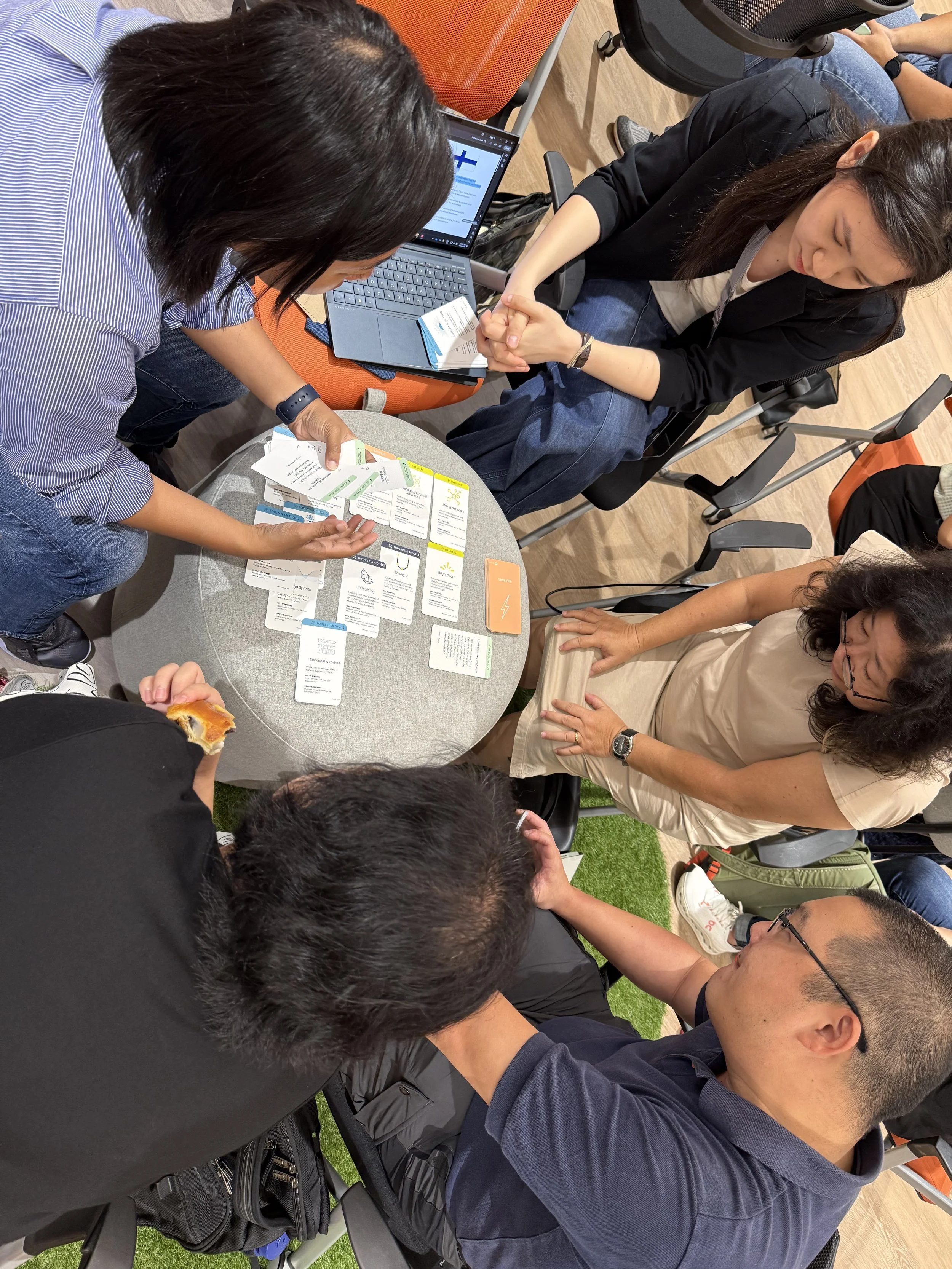
A Transformation Deck workshop isn't a lecture or a training. It's closer to play. Yet it's purposeful, creative and facilitated play that sets the conditions for collective action.
Participants move through a guided session using the physical card deck a shared Miro board or paper worksheets. Along the way, they surface barriers and enablers in their own context — not abstract ones from a case study, but real ones from inside their organization. They identify theories and methods that are already at work in their systems, often without realizing it. And they leave with a game plan; a portfolio of actions they've created together.
One participant from our session at the Singapore Civil Service College described it this way: "The Transformation Deck turned abstract ideas into concrete insights we could immediately apply to our work."
Another noted what made it different: "It was refreshing to engage in open dialogue about what helps and hinders innovation across government."
That quality of honesty — across agencies, across hierarchies — is rare. The deck creates the conditions for it.
Why play works
There's a reason this format cuts through where conventional approaches don't.
Play is disarming. When the structure of a game holds the conversation, people speak more freely. The card becomes a container for the idea — no one has to own it, defend it, or protect themselves from it. That's not a small thing inside bureaucratic systems where candour carries risk.
The deck was designed with that in mind. Three things drove its creation:
To help teams explore a wide range of transformation concepts without relying on recall or prior knowledge
To create disarming, candid conversations about strategic context
To help teams think broadly — across card suits and personas — using a diverse set of lenses
The Singapore workshop brought together leaders from across ministries. Participants called it "a well-curated, interactive session with rich international examples and meaningful discussions across agencies." What they valued most was the blend: "reflection, dialogue, and play" that created "genuine connection among participants."
What's next
Cards Against Bureaucracy is now available to explore online.
If you want to see how it works before bringing it into your organization, the demo is live at shiftflow.ca/transformation
If you're ready to go deeper, we're now booking in-person sessions. These are designed for leadership teams, cross-agency working groups, or any group that needs to move from knowing to doing — and is willing to have the real conversation to get there.
Most teams don't need another meeting. They need a different kind of conversation. This is how you start one.