Why Budget Cuts Without Resource Reallocation Rarely Transform Systems
Austerity that reduces total resources while preserving flow logic is contraction, not transformation. If you don't re-plumb the pipes, turning down the water pressure just produces a weaker flow to the taps.
 Nicholas Scott
It's budget season, and austerity is back on the agenda across Canadian governments.
From coast to coast to coast, public servants are searching every nook and cranny of the bureaucracy to balance the books. That effort carries its own costs. Time and attention are pulled away from value-creating work. Productivity drops. Morale erodes.
For months, I have been grappling with a basic question: in a system with a structural deficit, do austerity-style cuts that reduce budgets without changing underlying resource flows simply reproduce the same results at a lower quality?
Systems thinking suggests a clear answer: resource flows matter because systems behave the way they do largely through their interconnections, many of which are flows. Think of information flows that shape decisions and behaviour.
In FSG's Water of Systems Change, resource flows are defined as the allocation and distribution of money, people, knowledge, information, and other assets such as infrastructure.
This matters because resource flows operationalize priorities. They translate purpose and values into repeatable patterns, month after month and fiscal year after fiscal year, until those patterns become "just how things work."
From the perspective of resource dependence theory, resources and control over them are foundational to organizational behaviour.
The question is not only "what are we doing?" but "what are we feeding and with what?"
That is why budget models, staffing models, procurement rules, reporting regimes, and decision rights matter so much. They do not just support the system. They reproduce it.
Technologies, infrastructures, regulations, routines, and investment patterns reinforce one another over time. Once entrenched, they create persistent barriers that make alternatives harder to pursue, even when those alternatives are attractive. This is path dependence.
If the budget model stays the same, and the staffing model stays the same, and the procurement model stays the same, then the system has a strong tendency to keep producing the same outputs.
The incumbent system persists partly because the flows keep feeding it.
When cuts are applied without rewiring how resources are allocated and governed, organizations usually preserve the same operating logic until slack is exhausted. What follows is deterioration. Service quality declines. Risk and workload concentrate. Costs spill into other parts of the system, or onto communities and households.
Cuts to upstream services such as social care and local public services, for example, are often associated with greater downstream pressure on hospitals and worse population health outcomes. Demand does not disappear. It reappears somewhere else, often in a more expensive or harmful form. At Home/Chez Soi is a useful example of how preventive investment can produce downstream savings instead.
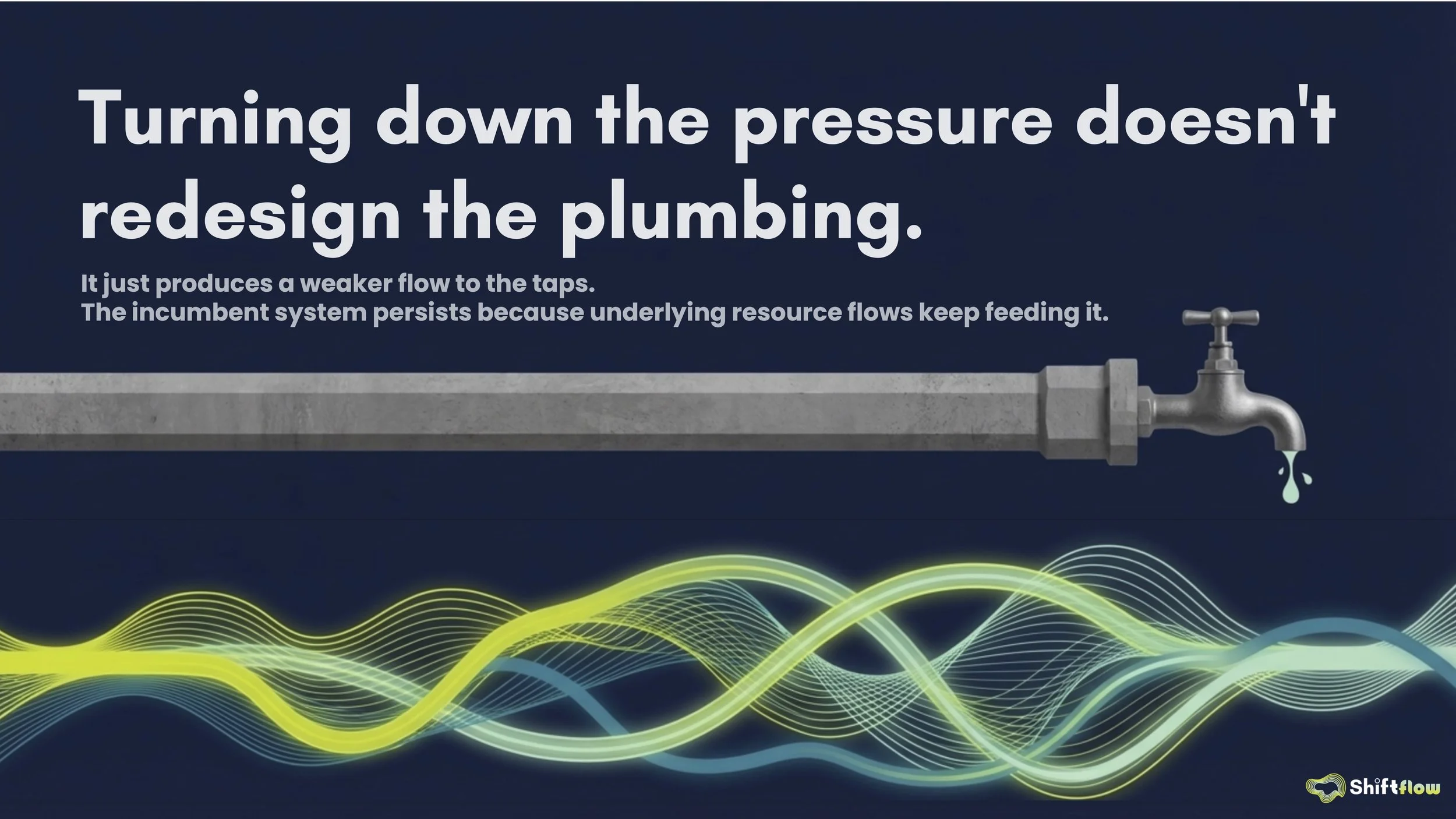
If you do not re-plumb the pipes, turning down the water pressure does not redesign the plumbing. It just produces a weaker flow to the taps.
Systems change is about shifting the conditions that hold a problem in place. That means changing interconnections, not just reducing elements. In this context, innovation means creating new value under changing conditions. Sometimes that requires a radical rethink and transformation of the structures and interconnections that make up an organization.
Most cut actions, however, reduce elements such as budgets and headcount while leaving interconnections intact. Incentives remain the same. Roles and capabilities remain the same. Allocation rules remain the same. Reporting regimes remain the same. Eligibility rules remain the same. Upstream and downstream handoffs remain the same. When those interconnections stay stable, the system tends to reproduce familiar patterns under greater strain and with worse effects.
In a period of austerity, two strategies usually emerge.
The first is across-the-board cuts. These are fast, require little analysis, and are often seen as politically equitable. But they are blunt and insensitive to different needs, functions, and production realities. They reduce fuel without changing the engine.
Across-the-board cutting, sometimes called decrementalism or salami-slicing, is a good example. It often preserves the existing service mix and power structure while shrinking capacity. The result is not transformation. It is strain.
The second is targeted cuts. This approach is slower and more analytical. It requires governments to make choices, confront trade-offs, and navigate political conflict. The 1994–1996 federal Program Review is an example. This strategy can align reductions more closely with priorities and results.
But even targeted cuts often preserve the status quo if they do not challenge the system's underlying logic.
That is where two paradoxes emerge.
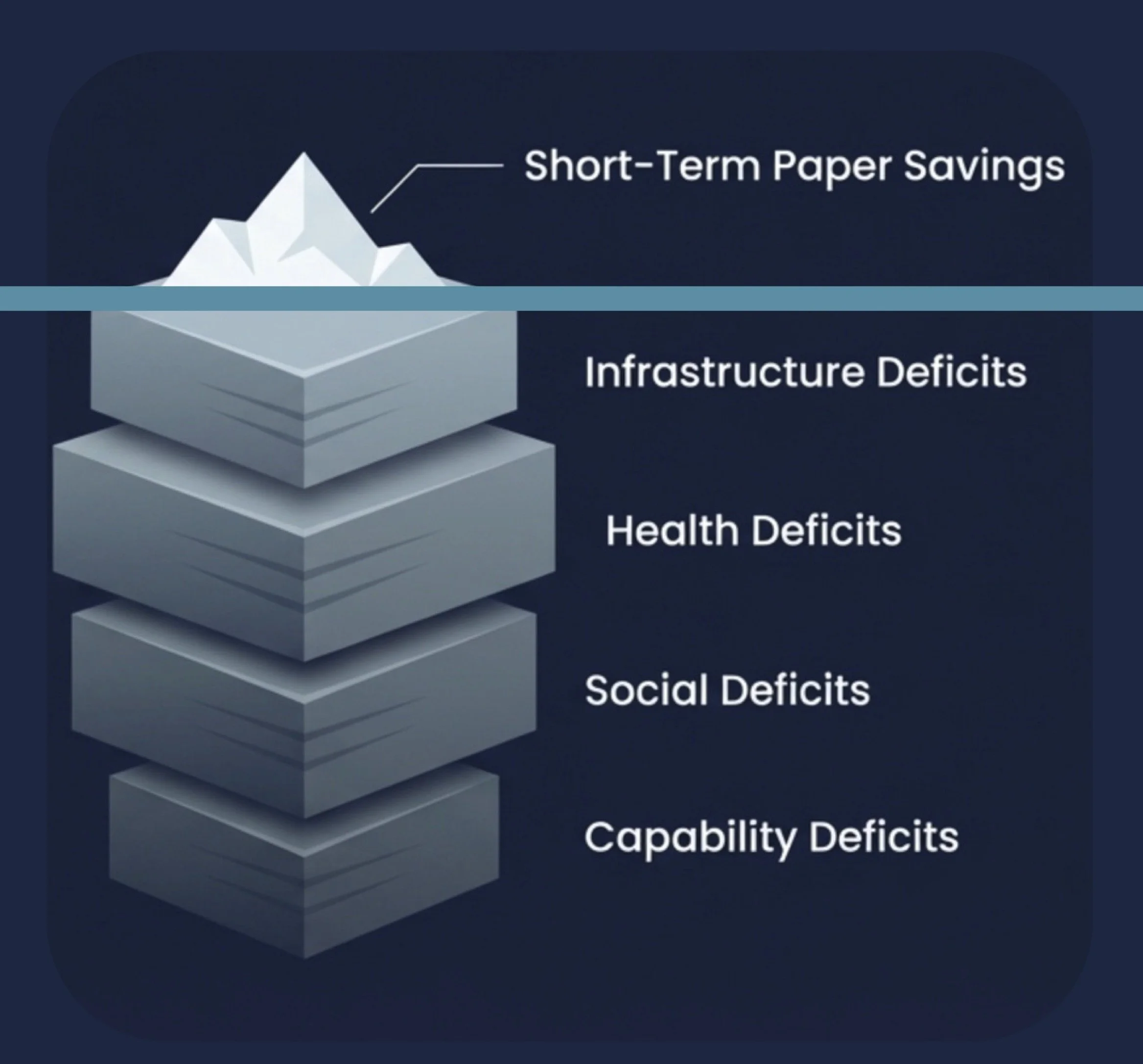
The first is the outcome paradox. Crisis-period choices often trade short-term savings for long-term costs. A government can appear to balance on paper while accumulating other deficits: infrastructure deficits, health deficits, social deficits, and capability deficits. Eventually, these deficits manifest as reduced revenue and higher costs.
The second is the capacity paradox. Cutback periods demand more disciplined analysis, planning, and redesign at the exact moment when fewer resources are available to do that work. In other words, the deficit system cuts away the government's own ability to make informed decisions about how to respond to the deficit.
This can become a self-defeating cycle. Cuts reduce outcomes or analytical capacity. Reduced capacity leads to weaker decisions. Weaker decisions worsen outcomes and create new costs. The deficit problem the government was trying to solve in the short term becomes harder to solve over time.
Governments often underinvest in the transformations needed to escape this cycle. Even in better fiscal periods, some choose to pay down debt while allowing capabilities to atrophy, or to preserve existing structures, incentives, and routines rather than redesign them.
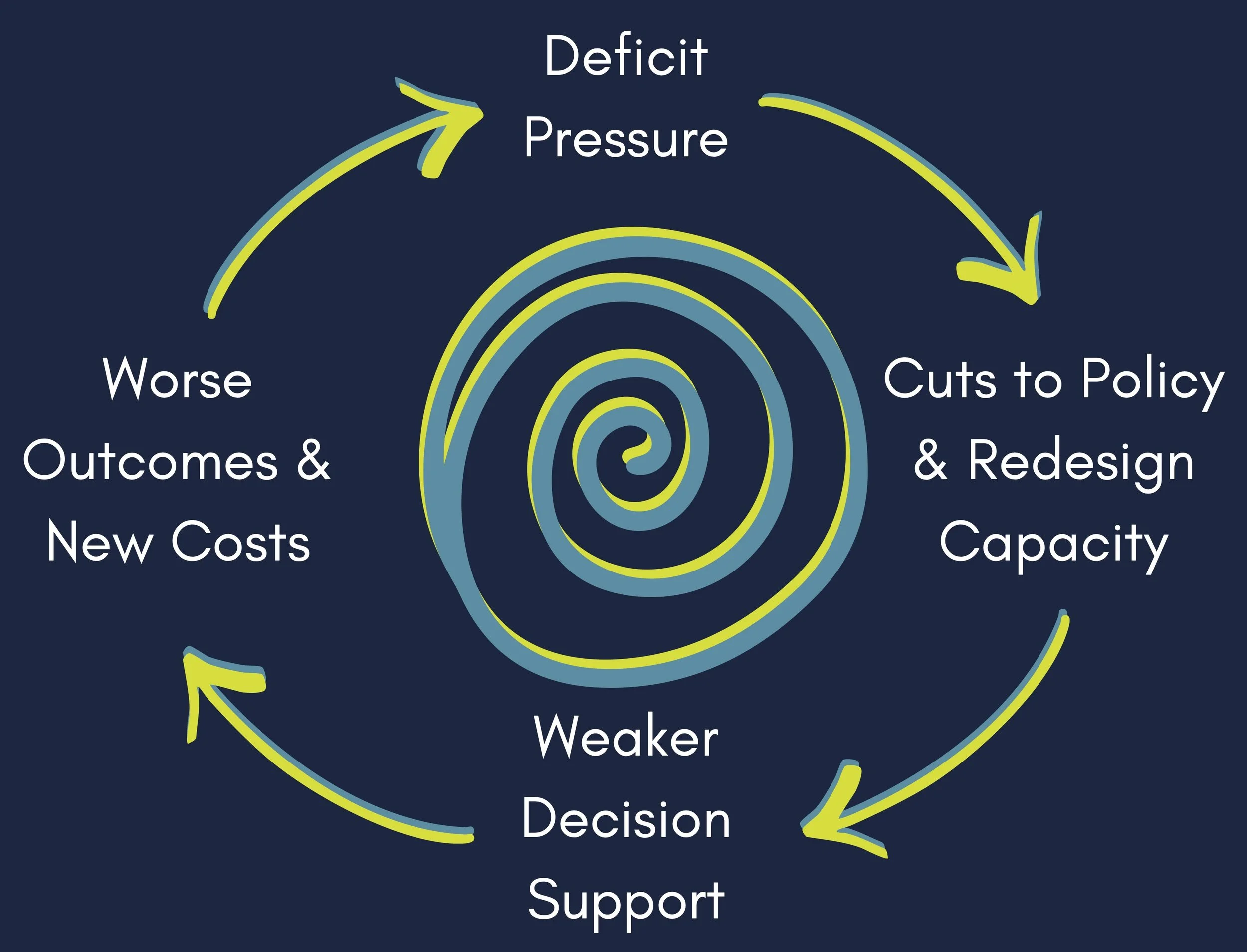
Austerity that reduces total resources while preserving flow logic is contraction, not transformation.
It also directly diminishes the system's capacity to redesign itself. Staff morale is part of that story. Budget cuts generate strain, uncertainty, rumours, and fear. Across-the-board cuts in particular tend to increase workload and stress, reduce trust and commitment, and drive away talented people. As that happens, workflows fray, networks weaken, and organizational learning becomes harder. Silos harden. People protect territory.
As former federal Clerk Jocelyn Bourgon put it, "Giving departments a target – be it three, five or 15 per cent – prevents them from coming forward with ambitious ideas."
So what does transformation under constraint look like?
To be clear, this is not an argument for ignoring the deficit. Nor is it an argument for simply adding more resources to a system whose logic is already producing poor results. The point is that governments need to govern across multiple horizons at once.
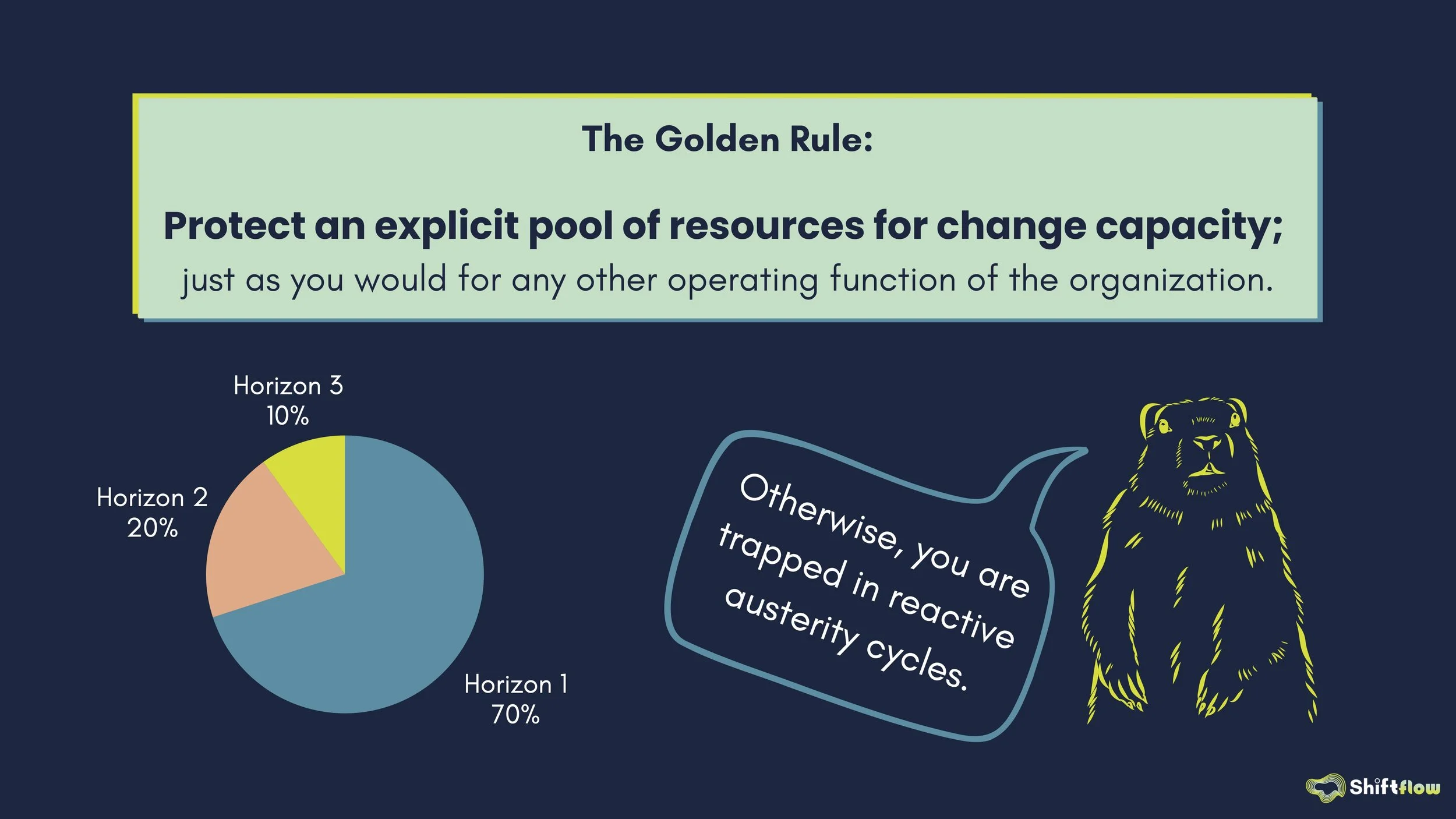
Horizon 1 work is about stabilizing essential services and responding to immediate fiscal pressure. Horizon 2 work is about redesigning resource flows, delivery models, and operating practices so the system can adapt. Horizon 3 work is about building the longer-term governance, capabilities, and institutional arrangements for a different future state. If all effort is concentrated on Horizon 1, governments get trapped in cycles of reactive austerity. If they continue investing mainly in Horizon 1 structures, they risk feeding the same broken dynamics. Transformation requires deliberate work on Horizons 2 and 3 in parallel with Horizon 1.
This means redirecting resource flows, not simply reducing or increasing total inputs within the current logic. That is more than changing which programs get funded. It is deliberately investing in redesigning the organization that delivers them so it can adapt to changing conditions. It means preserving enough analytical and operational capacity to reshape the system while under pressure.
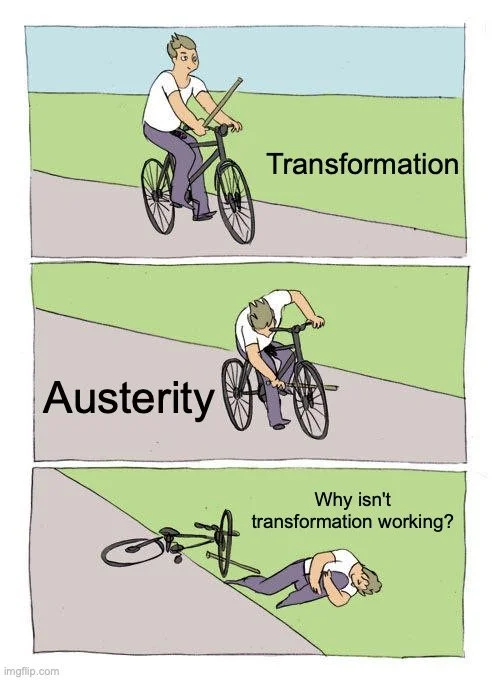
Innovation should be treated as a core function of the organization.
When deficit pressure is chronic, governments should protect an explicit flow for change capacity (e.g. analysis, service redesign, digital and operational enablement, and workforce transition support) or risk becoming trapped in a reactive austerity cycle.
This is part of what made the 1994–1996 federal Program Review more than an exercise in salami-slicing. It was framed not simply as cutting, but as reallocating diminished resources to priorities and changing program roles and delivery. Yet it was episodic rather than an ongoing capability.
When a deficit-running system applies austerity without changing underlying resource flows, it tends to preserve the same dynamics while reducing adaptive capacity. At first, this can look like doing the same with less. Over time, it leads to deteriorating service quality, cost shifting, and, at times, fiscal underperformance due to weaker growth and higher downstream demand.
Resource flows are the organization's gravity. Strategy documents and policy express intention, but gravity determines what reliably falls into motion. If you want transformation, you have to change the system's centre of gravity.