Campfires, Trails and Warm Data
When the most valuable work resists documentation, the document still wins.
We have all heard the term "paper pusher." What I did not realize going into government was the true extent of which paper is pushed. I previously thought it simply referred to moving forms around. It is much deeper than that.
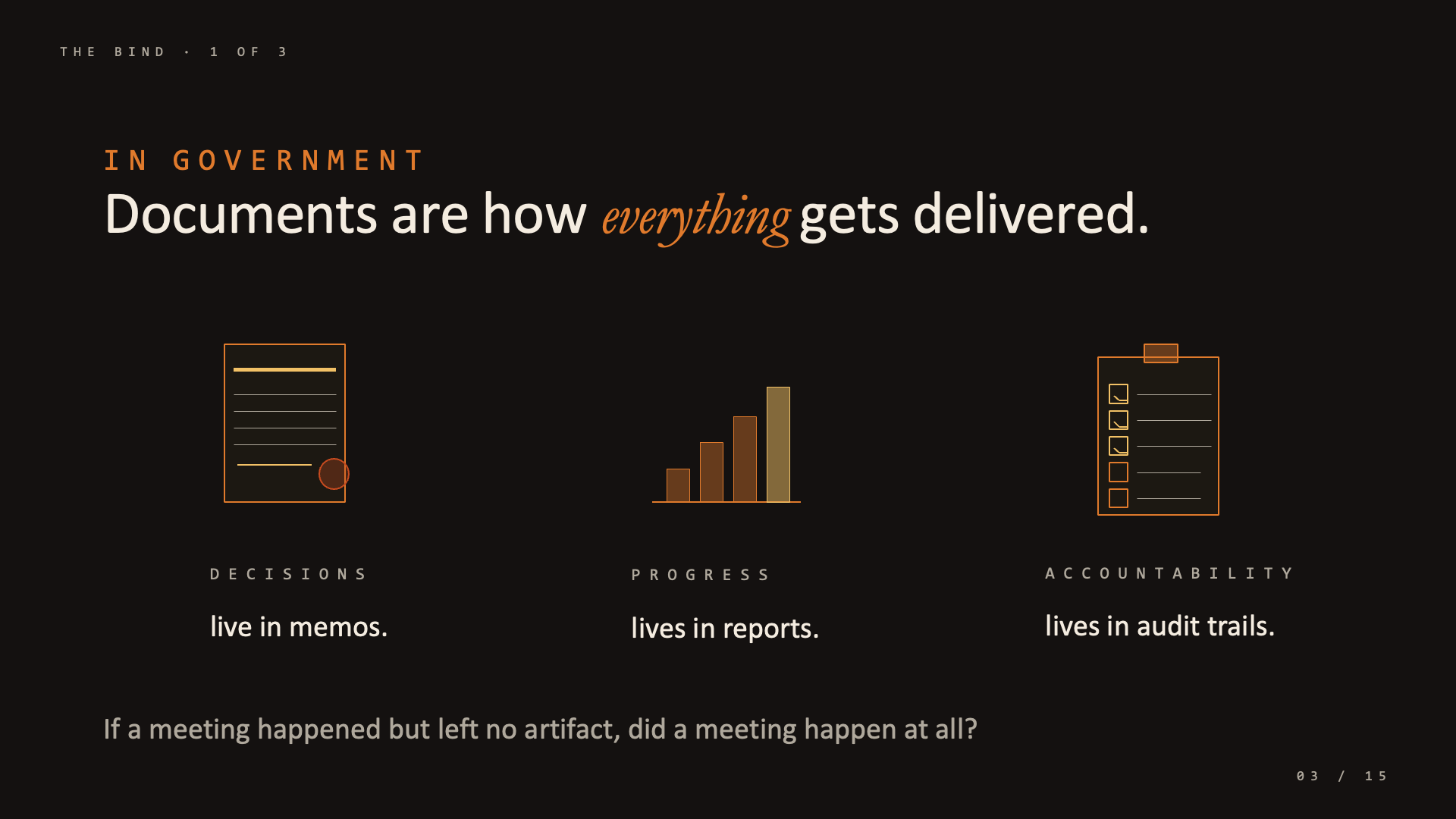
In government, documents are how everything gets delivered. Decisions live in memos. Progress lives in reports. Accountability lives in audit trails. If a meeting happened but left no artifact, it may as well not have happened. This is what is often considered "getting things done" in government. It creates a bind that cuts right to the heart of what we do.
The bind goes like this: the most valuable thing we produce is the space. It's a space where people think differently, make connections they couldn't make alone, and leave with clarity they didn't arrive with. That's fundamentally social. It's relational. It resists being flattened into a PDF. But the PDF is what gets read on Tuesday morning when the people who weren't in the room need to act (or not) on what happened.
Documentation as legitimacy, not just record
The document serves two distinct functions, and conflating them causes problems. The first is obvious: record-keeping. What did we decide? What's the status? Who's accountable? The second is less discussed but more consequential in institutional contexts: proof of work.
Facilitation and sensemaking face a persistent risk of dismissal. The work looks like talking. It looks like a meeting. Without a strong artifact, "nice but not productive" becomes the framing that sticks, especially in environments where productivity is narrowly defined as output. Documentation becomes the defense against that dismissal. It says: something real happened here, and here's the evidence.
The document doesn't just record what happened. It argues that what happened matters.
This reframes the job of the artifact entirely. It's not a neutral transcript. It's an advocate. And advocates need to speak the language of the audience they're persuading. In government, that means a language built on precedent, structure, and familiarity.
The Trojan Horse problem
Here's where novelty becomes a liability. If the artifact looks too different from what the institution already knows, it triggers an immune response. The new format or language gets rejected before its contents get evaluated. Adoption fails not because the work was poor, but because the container felt foreign.
So organizations face a genuine dilemma: produce something radically new and risk rejection, or produce something familiar and risk disappearing into the noise of all the other documents that look exactly the same. The conventional document format is both the path of least resistance and a form that strips out everything that made the original experience valuable.
The tension is this: intangible work needs to become tangible enough to be legitimate without becoming so conventional that it loses its substance.
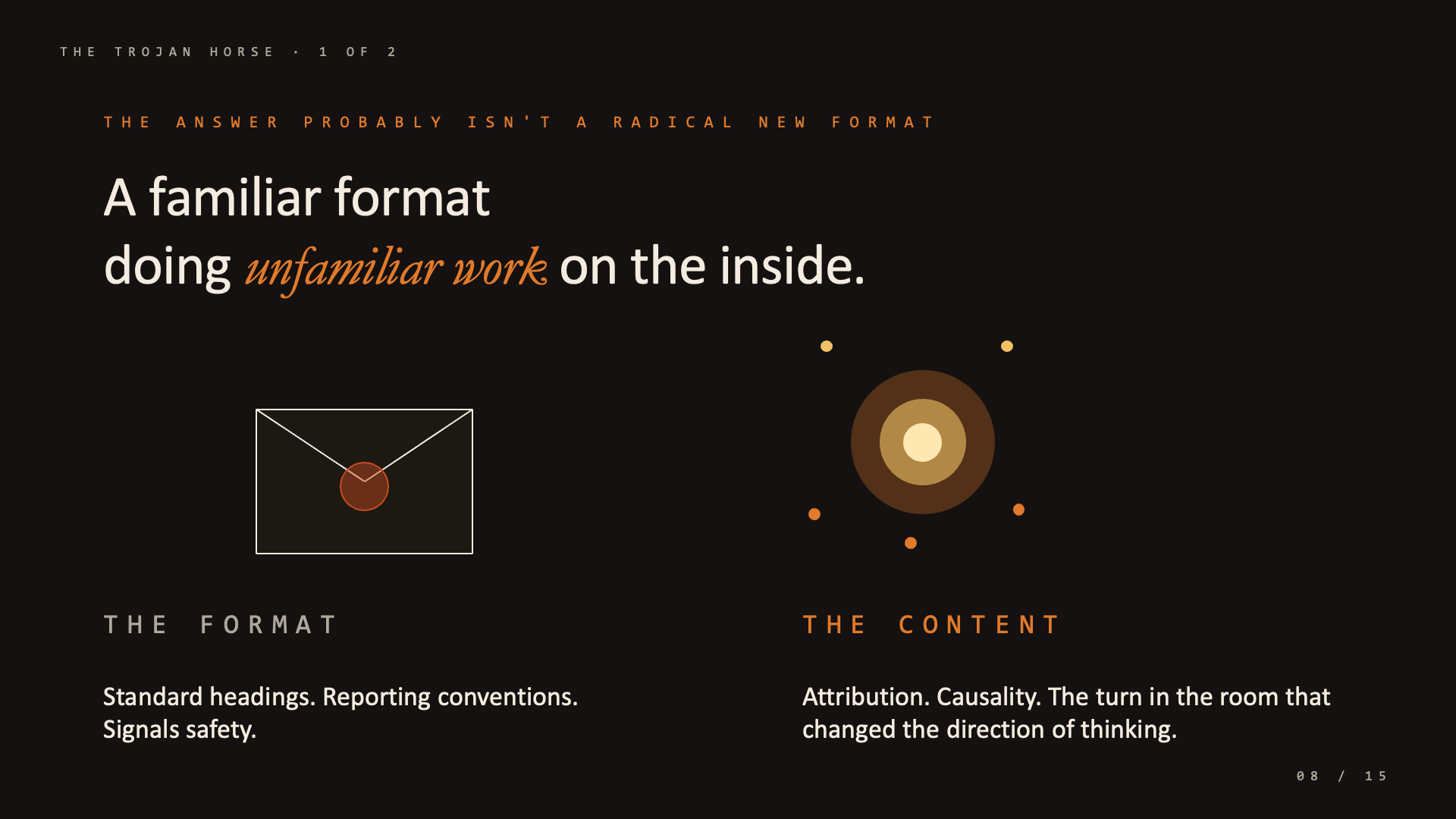
The answer probably isn't a radical new format. It's a familiar format doing unfamiliar work on the inside. That distinction matters more than it sounds. A well-designed readout that uses standard headings and reporting conventions can still carry real texture inside those containers — attribution, causality, the turn in the room that changed the direction of thinking. The format signals safety. The content does the actual work.
But there's a harder version of this problem. Sometimes the familiar container isn't just a compromise, it's a trap.
Institutions sometimes prefer the cold version. A document that captures ambiguity, contested interpretations, or a shift in thinking that implicates existing decisions can be a threat. When the person carrying the artifact has an interest in managing what it reveals rather than amplifying what happened, the familiar format becomes useful cover. Conventional headings, neutral language, and sanitized conclusions can make genuinely disruptive content invisible without anyone having to say so explicitly. The container normalizes what's inside it.
That's the risk you're always navigating. And it's a political risk, not a design one.
What makes it harder is that the sanitisation doesn't always happen on the way out. It can happen before the session even begins: in how the brief gets framed, which questions get scoped in or out, which stakeholders are named as the audience. By the time the room convenes, the artifact is already being shaped. No amount of careful facilitation fully recovers from a brief that was written to foreclose rather than open.
Why AI summaries fail this test
The tempting shortcut is AI-generated summaries. Paste the transcript, get the key points, ship the document. Fast, legible, consistent. For record-keeping, it works reasonably well.
But the problem with AI summaries isn't really about the tool. It's about whether the person generating the artifact understood what happened in the first place. A human-produced readout written by someone who was physically present but intellectually absent produces the same hollow result. The AI version just makes that hollowness faster and more confident-looking.
What both miss is the texture of what happened. Real sensemaking carries warmth in it. Relationships between ideas. The specific reason why one framing landed and another didn't. The thing someone said that shifted everyone's thinking. These don't survive the summarization pass, human or automated. They get compressed into bullet points that look like insights.
Someone who wasn't in the room reads the summary and thinks they understand what happened. They have the conclusions without the context that makes those conclusions actionable. That gap is where good work quietly dies.
Conversely, automation of a variety of tasks can free up time to focus on these aspects that are typically neglected. AI can make it faster to experiment with new formats that better capture and illustrate warm data. Speed up the analysis of meeting summaries or surveys. I once experimented with iBook Author to create supplementary versions of reports in an interactive ebook format. Before that, I tried Prezi. Before that, I used HTML. In each case, the effort was too great to sustain the practice. AI drastically reduces the effort and opens the possibility of capturing warm data.
Campfires, trails, and warm data
Two metaphors help clarify what we're actually trying to produce.
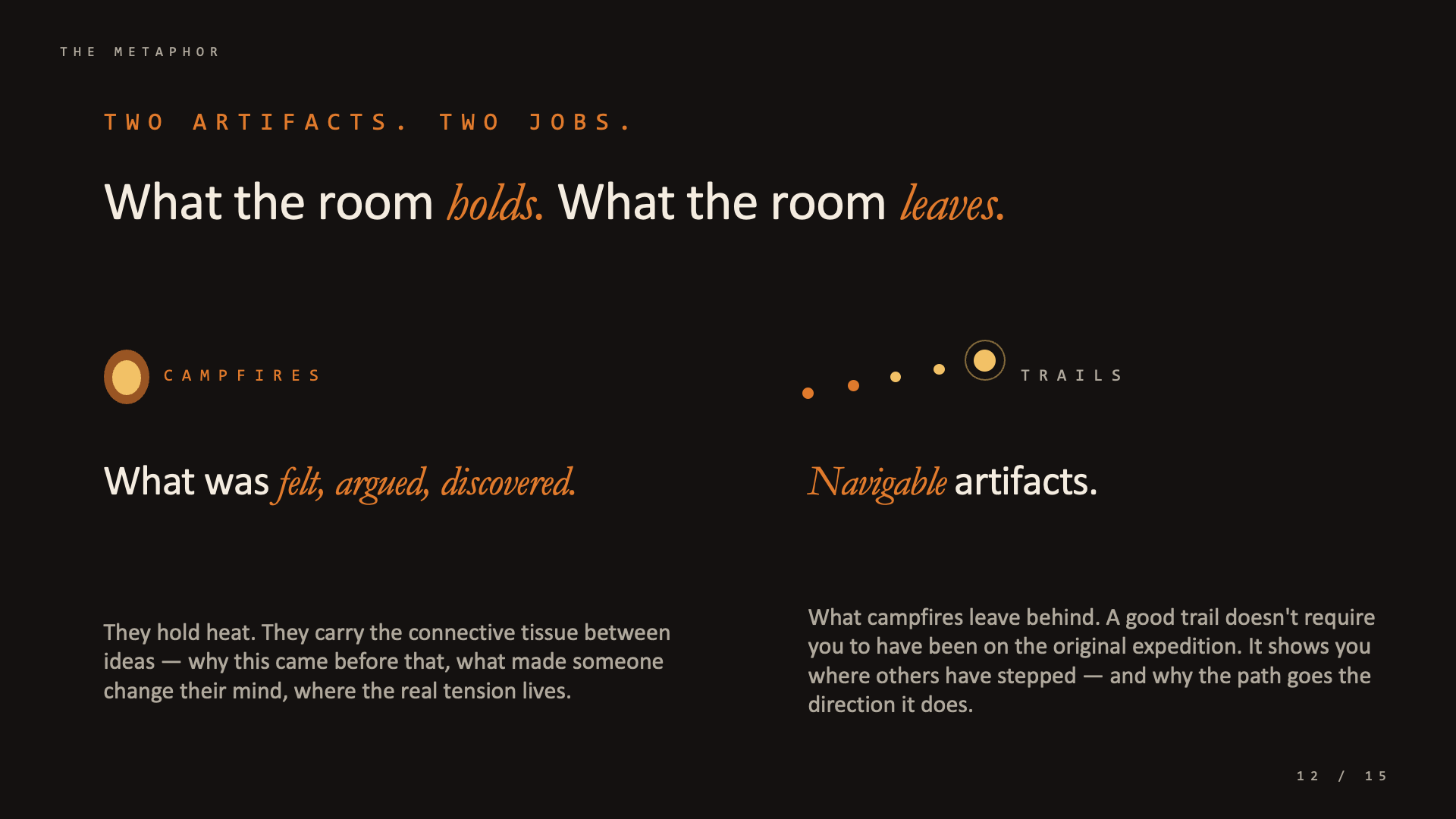
Campfires are the living record of a conversation. When I think about the time I've spent in workshops I've facilitated, it feels more like time spent around a campfire. I don't necessarily remember what was decided, but what was felt, shared, and discovered. These memories hold heat. They carry the connective tissue between ideas: why this came before that, what made someone change their mind, where the real tension lives. 'Campfire' documents preserve enough relational context that someone coming later can understand not just the conclusion but the experience.
Trails are what campfires leave behind. They are navigable artifacts that let people move through the thinking without having to reconstruct it from scratch. A good trail doesn't require you to have been on the original expedition. It gives you footing. It shows you where others have stepped and why the path goes the direction it does. Portfolios and case studies in the design world do this well.
The goal isn't to capture the full warmth of the experience. That's impossible and probably not necessary. The goal is to produce something warm enough to enable real action, not just informed inaction. Something that reads like it was written by someone who understood what happened, not just what was said.
Most artifacts are structured, legible, and cold at the core. The challenge is warmth.
The handoff as a problem
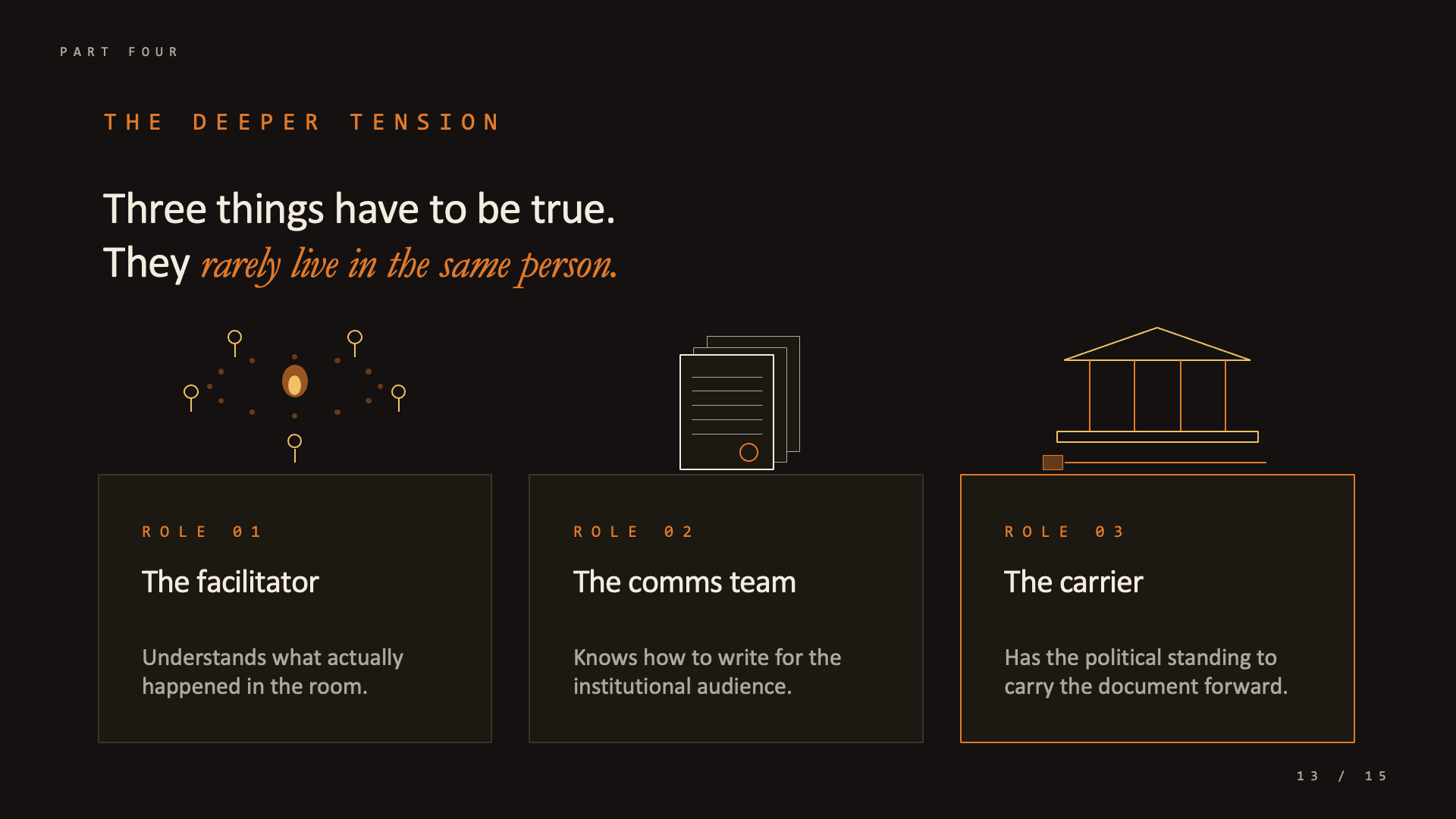
Three things need to be true for an artifact to do its advocacy job: someone has to understand what actually happened in the room, someone has to know how to write for the institutional audience, and someone has to have the political standing to carry the document forward. Those three things rarely live in the same person. The facilitator has the first. The comms team has the second. The senior responsible officer has the third. Getting all three into the production of a single readout is genuinely hard.
The practical question is who writes the readout when the person with political access wasn't in the room. That question has to be settled before the session, not after. What that looks like in practice is a brief conversation, as short as fifteen minutes, where the facilitator and the document's eventual carrier walk the arc of what happened together. Not a debrief. Not a summary handoff. A conversation about what shifted, what surprised, and what the room was ready to act on that it wasn't ready for going in. The carrier then writes from that conversation, not from the transcript.
The fifteen-minute conversation assumes the carrier wants to know what shifted. Many do. But some don't — because what shifted may complicate their position, contradict an earlier commitment, or open a conversation they'd rather not have. In those cases, the handoff doesn't fail because it was poorly designed. It fails because the carrier's incentive is to let the heat cool, not carry it forward. That's not a facilitation problem. That's a power problem.
The facilitator's real leverage in that situation is limited, but it isn't zero. The most consequential insight needs to be inside the document's own language, early, where it can't be edited out without leaving a visible gap. That's not elegant. It's damage limitation. But it's honest about what the facilitator can actually do when the person holding the document has reasons to manage what it reveals.
The structural question underneath all of this is: what conditions make a carrier want to surface what shifted, rather than smooth it over? Accountability structures that reward honesty about complexity. Relationships with enough trust to make surprising a decision-maker feel safe rather than career-limiting. Commissioning processes that name "what challenged our assumptions" as a deliverable, not an optional extra.