New Look, Who 'Dis?
Real change is harder than most change programmes acknowledge, and the gap between what organizations say about change and what they actually do is where most transformation efforts quietly die.
 Nicholas Scott
Three Years of ShiftFlow
Three years ago, I launched ShiftFlow with a single mission: help shift organizations away from bureaucratic indifference and toward life-affirming alternatives.
The launch post named the problem directly. Wicked problems persist because organizations stay locked in patterns that cannot address them. Banks. Insurance companies. Telecoms. Government most of all. At best, the experience is inconvenient. At worst, it is harmful. The pitch was that a different kind of firm could help organizations move toward something better. More human-centred. More adaptive. More capable of evolving long after the consultants have left.
That conviction has only sharpened.
Three years of client work have taught me to say it more directly.
The position is this: real change is harder than most change programmes acknowledge, and the gap between what organizations say about change and what they actually do is where most transformation efforts quietly die.
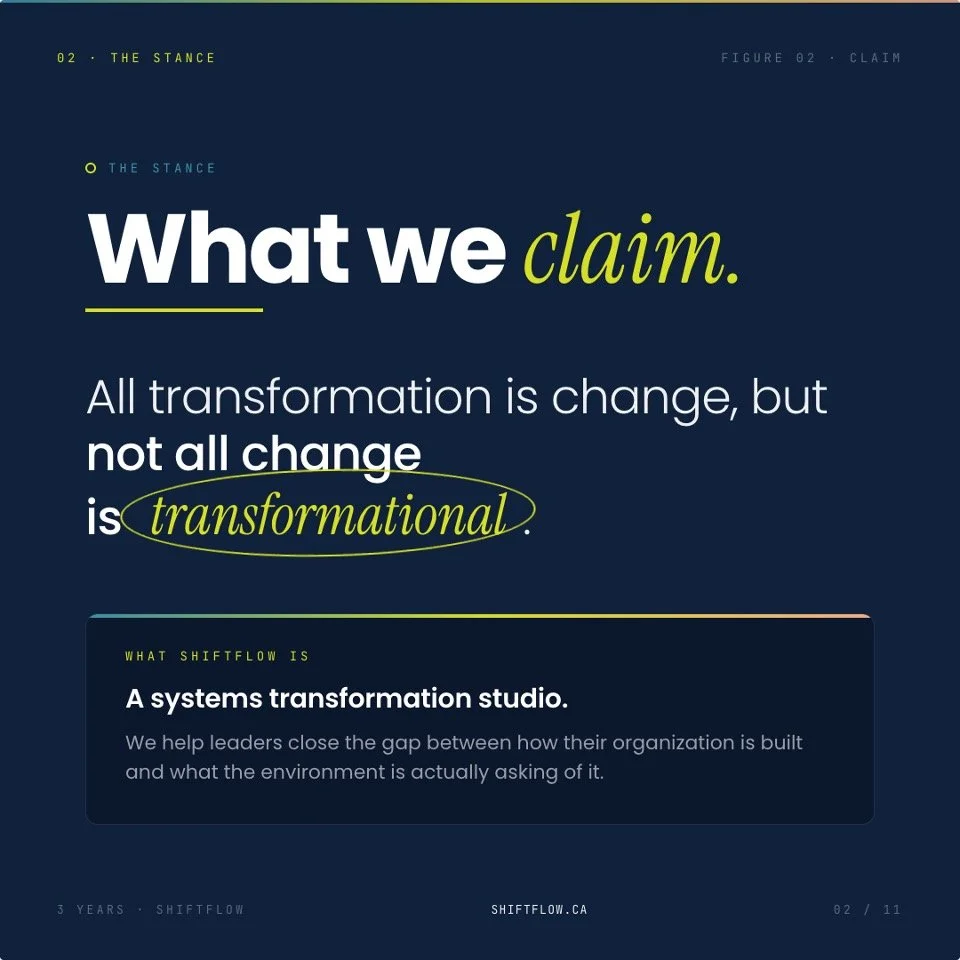
This is Deep Change. All transformation is change. Not all change is transformational. Roadmaps, rollouts, programmes with glossy artifacts. With the best of intentions, we often see activity without consequence. The culture holds. The incentive structures hold. The assumptions hold. Then the leaders watch the outputs slip back into the old shape.
That gap is where the real work lives. It is also where most consulting does not.
A second thread became impossible to ignore over the last eighteen months. AI now enters almost every conversation. The questions are urgent. The answers tend to fall into one of two extremes: too optimistic or too fearful. This is not helped by the over-emphasis on resource savings through automation, which entirely misses the step changes afforded by augmentation and multi-player approaches to AI use.
AI lands in organizations where the soil is already healthy, in teams that function well, in systems with clear decision rights and high trust. It also lands in the struggling places, in the fragmented processes, in the cultures where trust has worn thin. There, it makes the existing shape visible. Sometimes it widens what was already cracked. Other times, it fossilizes precisely what is producing the undesirable outcomes.
The line I have started using is this:
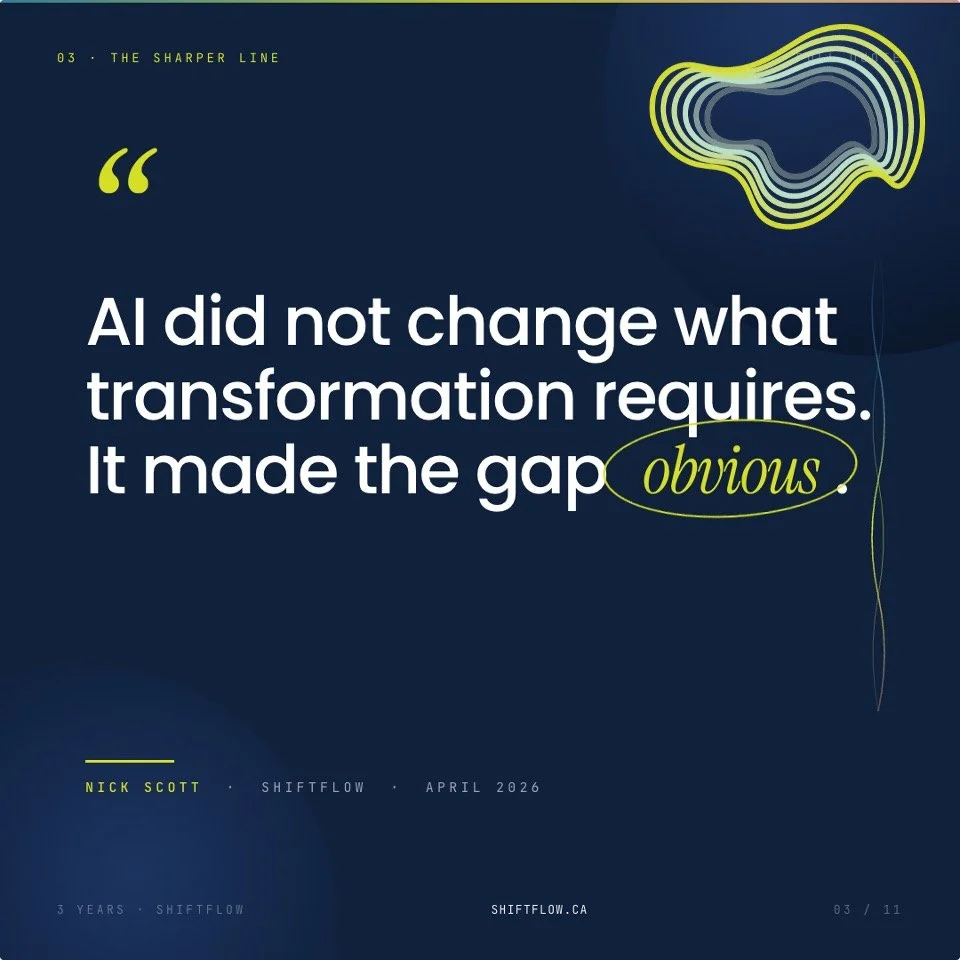
AI did not change what transformation requires. It made the gaps obvious.
The gaps were not invisible before. People living in dysfunctional systems have always known where the cracks are. But a language model exacerbates trust gaps. Closing them is human work. An automation pipeline runs at the speed of the culture that built it. The hard work stays hard. AI just amplifies the noise and runs the clock faster.
This is why organizational health has to come first. Closing the gaps is human work. That has not changed.
Both threads, Deep Change and the gap AI made visible, now sit at the centre of the practice. They show up in client engagements, in workshop design, in everything we publish.
And as of today, for the first time, they share a permanent home.
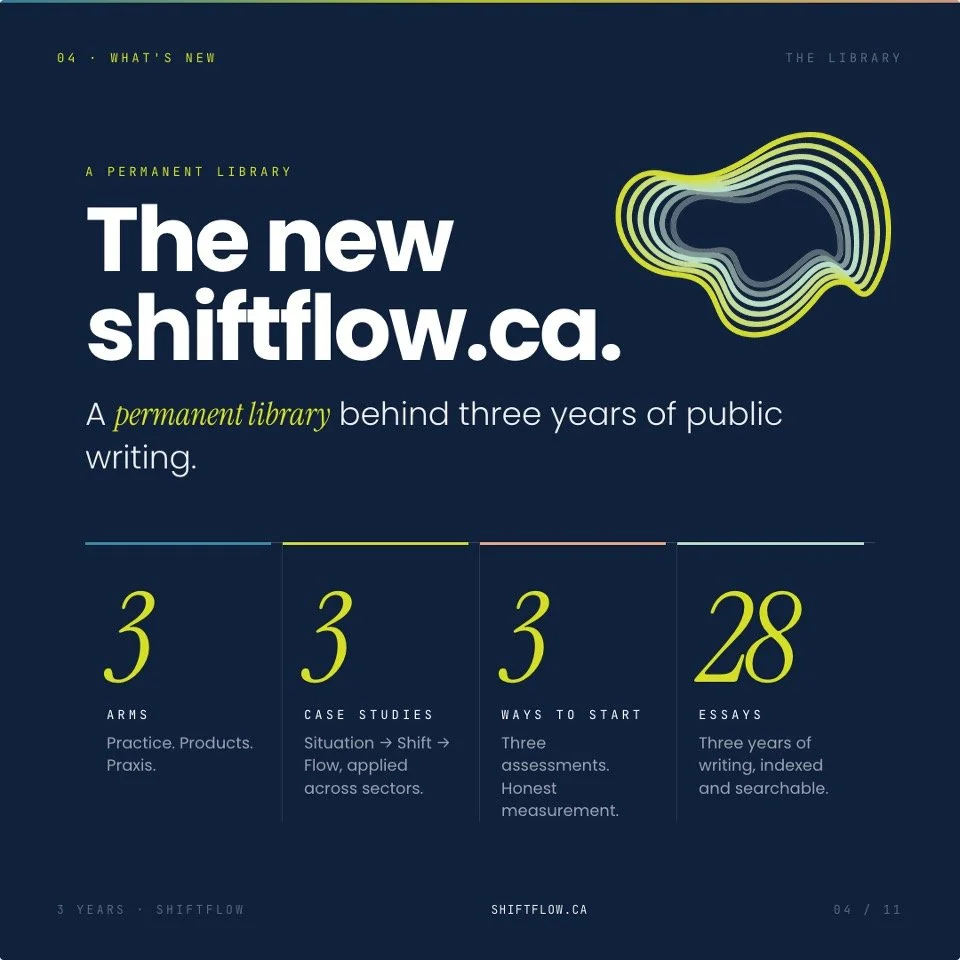
The new ShiftFlow site is live: beta.shiftflow.ca
Three years of work, consolidated and organized. A clearer articulation of what we do, who we serve, and what we believe about change.
Built around the waterline.
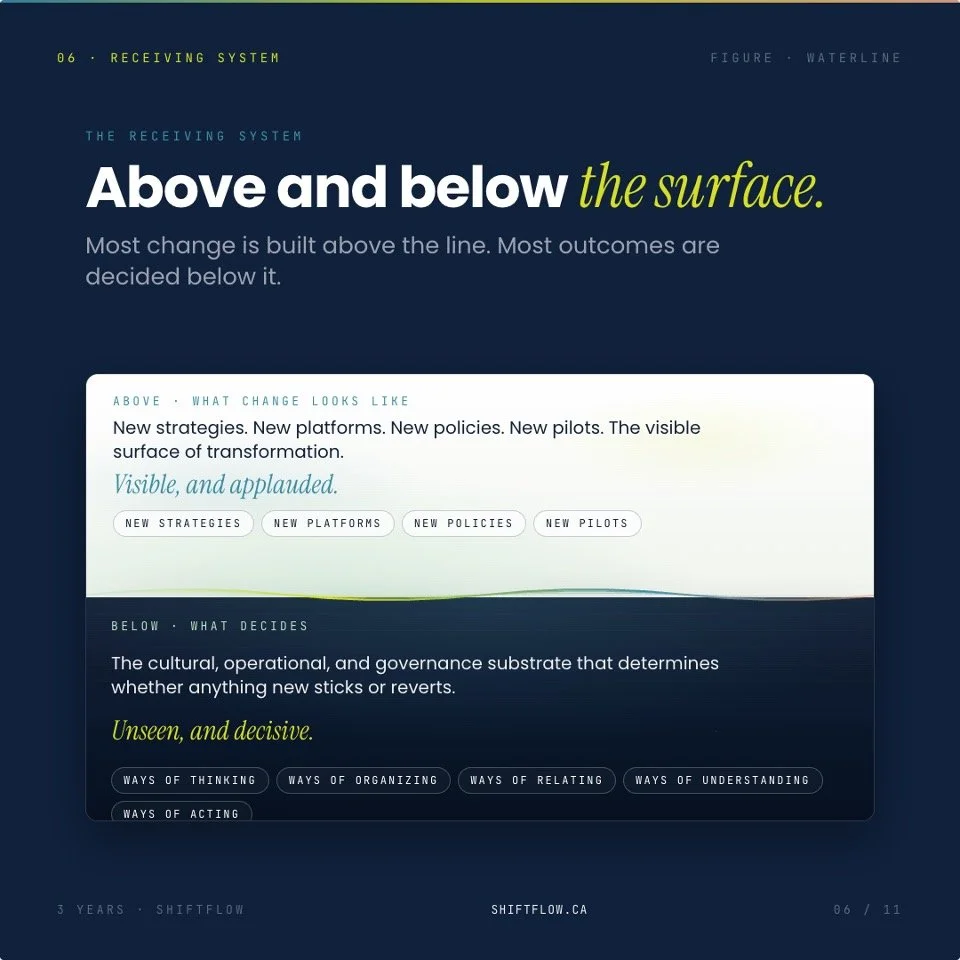
The whole site is organized around a single image. A waveform waterline runs across the screen. Above it sits what change looks like: launches, rebrands, new strategies, announcements. The visible surface of transformation is the part that is easiest to admire. Below it sits what actually decides the outcome: governance, incentives, operating models, skills, and data plumbing. The receiving system. Unseen and decisive.
Most consulting work sits above the waterline. The assessments and products described here are largely above it as well (i.e. diagnostics, card games, AI-powered advisory sessions). I want to be honest about that. A fifteen-minute diagnostic does not do below-waterline work. What it can do is name a pattern clearly enough that the people in the room decide they are ready to go deeper. Some results will tell you ShiftFlow is not the right firm for your next step. When that happens, we say so. The real work (the relational, political, slow-moving work of shifting culture) happens after that conversation, with real people, in real rooms.
Three assessments.
ShiftCX measures how your organization actually delivers customer experience. Twelve minutes, five dimensions, fifteen sub-dimensions, a report with one clear recommendation for where to focus.
Digital Transformation Readiness asks a sharper question: if you deployed AI tomorrow, would it stick or revert? Ten minutes, eighteen questions, six dimensions of organizational fitness, a report with your overall maturity and one concrete next step. Built on the methodology co-developed with colleagues at Think Digital Associates in 2023, updated for what AI has changed.
InnovationShift asks how your organization actually innovates: strategic intent, an authorizing environment, real capacity, disciplined method, citizen voice, evidence loops, and an ecosystem that helps the work travel. Roughly fifteen minutes, seven dimensions, twenty-one sub-dimensions, a report that names the pattern your innovation work has fallen into and one concrete next step. Built on a curated base of OECD, OPSI, Nesta, and peer-reviewed public-sector innovation literature, designed for senior leaders in government, health, social services, and mission-driven orgs.
None of the three reports is LLM-generated. Recommendations are authored against the score profile, the evidence base is curated, and the report is composed deterministically from your answers. The work lives in the evidence.
Three digital products.
Built on top of the practice. Each one takes something we do with clients in a room and makes it portable.
The Transformation Deck works a specific organizational challenge from five angles at once: Critic, Optimist, Academic, Practitioner, Philosopher. Each voice draws from its own suit of cards (Barriers, Enablers, Theories, Tools, Provocations) and deliberates in front of you before a synthesis. The Deck runs in two forms today: a paid in-person workshop with a printed deck, and a free AI-powered demo that produces insights, recommended actions, risks, and open questions on a challenge you bring in.
Vantage convenes a board of advisors around a strategic question you are carrying. You set the business context, pick up to three agents from across disciplines. You ask the question. You get a structured AI session: individual rounds from each advisor, a synthesis, and a tension map showing where the advisors disagreed. Pick your advisors for tension. That's where innovation lives.
Cards Against Bureaucracy is our facilitated icebreaker for anyone working in a bureaucracy. An online multiplayer card game puts shared vocabulary about dysfunction on the table. Play a round in about ten minutes, and end with a real laugh about the patterns your team operates inside every day. No AI in this one.
Measurement. Readiness. Play. Three angles, one principle: surface the truth about where you are.
The site marks a pivot we have been working toward for a while: from speaking primarily to the early adopters who already share the language of systems and transformation, toward the early majority doing real work in complex organizations who need practical thinking they can use.
The principles are the same. The way we share them has matured.
A question I grappled with
Is the client the shift disturber trying to get air cover inside their institution, or the executive who needs a credible outside mirror?
Both. And they need different things.
The executive needs to see the gap named without flinching. The shift disturber needs to know someone else sees what they see. The assessments are built to do the first. The deeper engagements that do not fit neatly into a product description are where the second happens. If you have read this far and recognized yourself in either description, that is probably enough to know whether a conversation is worth having.
The original launch post closed with an invitation to shift disturbers: people inside organizations who want to make a positive impact and need help doing it. That invitation still stands. The work has just become clearer about what it takes to pursue it seriously.
If you have been with ShiftFlow over the past three years, some of what you find on the site will look familiar. Some of it will look sharper. If you are new here, welcome. The short version: organizations are capable of more than most change programmes ask of them, and the work of transformation is harder, slower, and more relational than most frameworks admit. A fifteen-minute assessment will not change that. What it might do is start an honest conversation that a year of meetings did not.
Three years in, that conviction has deepened.
Explore the new ShiftFlow site → beta.shiftflow.ca
The gap between what organizations say about change and what they actually do is where the real work lives.